 Haplo
Haplo
Couch to 5K Plan: 9 Weeks From Walking to Running 5K
Three runs a week for nine weeks, from one-minute jogs to 30 minutes without stopping. Here is every interval, week by week, with how easy the jogging should feel, when to repeat a week, and how to tell normal soreness from pain that needs a professional.
Couch to 5K takes you from walking to 30 minutes of continuous running in nine weeks. You run three times a week, and every run mixes easy jogging with walking, with the jogs getting a little longer each week until the walking is gone. This is the Couch to 5K plan from Cinder, the workout tracker we make: pick your three days and it lays out each week’s runs, tracks each one and ticks it off when you finish.
Below is the plan exactly as the app ships it: the three sessions, every interval of all nine weeks, and the minutes the app gives each week. Around it is what a plan card can’t hold: how easy the jogging should feel, why the walking breaks matter, when to repeat a week, what to look for in shoes, how to tell ordinary soreness from shin pain, and what research on new runners says about building up.
Who this couch to 5K plan is for
Cinder’s own description says the plan suits “someone starting from very little running”, and that it works on a treadmill or outdoors. The first run lasts 30 minutes and 22 of those minutes are walking, so the real starting line is being able to walk briskly for half an hour.
If you’re worried about your health, have a heart condition, take a medicine that changes your heart rate (a beta blocker, for example), are pregnant, or are coming back from an injury, talk to a doctor or physio before you start. The NHS gives the same advice for its own Couch to 5K.
How the couch to 5K schedule works
Every run has the same shape: a five-minute brisk walk, a middle block that follows the week’s walk-jog pattern, and a five-minute easy walk. All three runs in a week are identical, and only the pattern changes from week to week: eight 60-second jogs in week 1, a single 20-minute jog in week 7, and 30 minutes without a walk in week 9. The full list is in the week-by-week section after the sessions.
The plan wants a day between runs. Cinder puts the three runs on the days you pick, in order, and warns you if two of them land back to back. The NHS plan asks for the same thing: a rest day between each run.
One thing to know before week 3. In the app, only the middle block grows with the weeks (the two walks stay at five minutes), and it grows by a set percentage: 20 minutes in week 1, then 21, 22, 23, 24, 25, 26, 28 and 30. The week’s pattern doesn’t always fill that block. In weeks 3 and 5 to 8 it finishes a few minutes early, and in week 4 it runs a minute over. Treat the pattern as the prescription. Our suggestion: when the pattern ends before the block does, walk the spare minutes or start your cool-down early, and don’t fill them with extra jogging.
How to follow the plan in Cinder
- Open the Plans tab, tap See all below the calendar, and find Couch to 5K under Running, or search for it.
- The plan’s page lists the three sessions and has a Week by week row from W1 to W9. Tap a week to see its pattern and how long each run takes.
- Tap Start this plan and choose your days. The picker starts on Monday, Wednesday and Friday if your calendar week begins on a Monday, or Sunday, Tuesday and Thursday if it begins on a Sunday. Underneath, your first week is laid out, with a warning if two runs land on consecutive days.
- Turn on Remind me on training days if you’d like a nudge (it starts at 6 pm and you can change the time), then tap Start.
- On the Home tab, tap +, then Add Widget, and add Today’s Plan. On a run day it shows the session with a Start Run One button (Run Two and Run Three later in the week). Cinder tracks the run with GPS (time, distance and pace), shows it on your lock screen as a Live Activity, and ticks the session off when you end the run.
- Cinder doesn’t tell you when to switch between jogging and walking, so for weeks 1 to 6 set an interval timer on your phone or watch, or keep an eye on the elapsed time. The NHS suggests the same: bring something to time your runs and walks.
- If you have to stop for a while, Pause the plan from its menu. When you resume, Cinder moves your start date forward by the whole weeks it was paused, so you carry on from the week you left. Start again from week 1 is in the same menu.
Three runs a week for nine weeks
Three identical runs a week: a 5-minute brisk walk, the week’s walk-jog pattern, and a 5-minute easy walk. The jogs grow from 60 seconds at a time in week 1 to 30 minutes without a break in week 9, and each run grows from 30 to 40 minutes in the app.
- Length
- 9 weeks
- Days a week
- 3
- Level
- Beginner
- Kit
- Somewhere to run or a treadmill
- Run One First run of the week. Follow this week's interval pattern. 5 min + 20 min + 5 min · about 30 min
- Run Two Same shape as run one. Rest a day first if you can. 5 min + 20 min + 5 min · about 30 min
- Run Three Last of the week. Nothing new, just the same pattern again. 5 min + 20 min + 5 min · about 30 min
Picking your three days
Week starts on Monday
- Mon · Run One
- Wed · Run Two
- Fri · Run Three
The three days Cinder picks for you when your calendar week starts on a Monday. Every run has at least one rest day after it, and Friday’s has two.
Week starts on Sunday
- Sun · Run One
- Tue · Run Two
- Thu · Run Three
What it picks when your calendar week starts on a Sunday, as it does with US settings. The same spacing, one day earlier.
Any three days with gaps
- Tue · Run One
- Fri · Run Two
- Sun · Run Three
Any three days work if none of them are back to back. The app numbers the runs in the order they fall in your week, so Run One is always your first run.
Both weekend days
- Wed · Run One
- Sat · Run Two
- Sun · Run Three
Cinder lets you, and says so: “Run Two and Run Three land on back-to-back days. The plan would rather have a day between them.” If you can move one, Monday, Wednesday and Saturday keeps a day between every run (our suggestion).
Run One
First run of the week. Follow this week's interval pattern.
The week’s first run is where the new pattern shows up, so read the week’s focus line before you set off. It’s in the week list below, and under Week by week on the plan’s page in the app.
In week 1 the whole run takes 30 minutes: 5 minutes of walking, 20 minutes of one-minute jogs with 90-second walks between them, and 5 more minutes of walking. By week 9 it’s 40 minutes, and the middle 30 are all jogging.
-
5 min
Walking
Brisk walk to warm up
Walk as if you’re a few minutes late: arms swinging, breathing a little quicker, still easy to talk. The NHS plan describes this walk as a way to raise your heart rate gradually and warm up your muscles before the first jog.
Swap On a treadmill, walk at a speed that feels brisk but comfortable, and only speed up when the first jog starts.
Source: NHS Couch to 5K plan
-
20 min · Talk test pace
Running
Follow this week's focus
The app lists this block as Running, 20 min, but it holds the week’s walk-jog pattern: in week 1, eight rounds of 60 seconds jogging and 90 seconds walking. Jog slowly enough to say a full sentence out loud, and keep walking briskly between jogs rather than stopping. If the last jogs feel much harder than the first, start slower next time.
Swap No safe route? A treadmill works just as well. Use the speed buttons for the switches and set the jog by the talk test, not by the number on the display.
Research: Persinger et al., 2004 Source: NHS activity guidelines
-
5 min
Walking
Easy walk to finish
Slow right down and let your breathing settle; the NHS plan uses this walk to bring your heart rate back to normal. It’s also the moment to notice how the jogs felt, because that, more than the clock, tells you whether you’re ready for next week.
Swap Walking home counts, as long as it’s five easy minutes.
Run Two
Same shape as run one. Rest a day first if you can.
The same run again, ideally after a day off. Nothing about it is new, so all your attention can go on keeping the jogs easy.
It works just as well indoors. Cinder lists a treadmill as the alternative to somewhere to run, and the talk test held up on a treadmill as well as a bike when it was tested in the lab.
-
5 min
Walking
Brisk walk to warm up
Use the walk to check in with your legs. Stiff calves or thighs a day or two after a new kind of exercise are normal, and muscle soreness usually eases once you’re moving. Pain in one spot on a bone, or pain that sharpens as you go, is different: see Sore muscles or shin pain? below.
Swap Indoors, walk briskly on the treadmill before the first jog, the same as you would outside.
Research: Armstrong, 1984
-
20 min · Talk test pace
Running
Follow this week's focus
The same pattern as Run One. If Run One felt hard, slow the jogs down before you think about shortening them, and keep the walks as walks: jogging through the breaks makes the session harder than the plan wrote it.
Swap On a treadmill, raise the speed for each jog and lower it for each walk. There’s no need to step off the belt.
-
5 min
Walking
Easy walk to finish
Five easy minutes, then a rest day before Run Three if your week allows it. The NHS calls rest days “just as important as the runs themselves”.
Source: NHS Couch to 5K plan
Run Three
Last of the week. Nothing new, just the same pattern again.
The last run of the week, and its checkpoint. If you get through the pattern at a pace where you could still talk, you’re ready for next week’s.
If you had to cut jogs short in two of this week’s three runs, repeat the week. That’s our rule of thumb, not the app’s, and there’s more on it under When to repeat a week.
-
5 min
Walking
Brisk walk to warm up
By the third run you know the route and the pattern, so let the walk be routine. If something hurts, as opposed to aching, this is the run to skip rather than push through.
-
20 min · Talk test pace
Running
Follow this week's focus
Run the pattern exactly as written, at the same easy effort as the first two. If you track distance, compare how far the whole session goes from week to week rather than your pace, which moves around with the weather and the hills.
Swap No measured loop? Any route works. The plan is timed, so distance doesn’t matter.
-
5 min
Walking
Easy walk to finish
Before your next run, read next week’s pattern so you know what’s coming. In Cinder it’s under Week by week on the plan’s page.
Couch to 5K week by week
-
Week 1
60 seconds jogging, 90 seconds walking. Eight times.
8 minutes of jogging. The pattern takes 20 minutes and fills the app’s middle block exactly. Each run: 30 minutes.
-
Week 2
90 seconds jogging, 2 minutes walking. Six times.
9 minutes of jogging in a 21-minute pattern, which again fills the block (20 × 1.05 = 21 minutes). Each run: 31 minutes.
-
Week 3
Two rounds of: 90 seconds jogging, 90 walking, 3 minutes jogging, 3 walking.
9 minutes of jogging in an 18-minute pattern, including your first 3-minute jogs. The app’s block is 22 minutes (20 × 1.1), so there are 4 spare minutes: walk them or start your cool-down early (our suggestion). Each run: 32 minutes in the app.
-
Week 4
3 minutes jogging, 90 seconds walking, 5 minutes jogging, 2.5 walking. Twice.
16 minutes of jogging, up from 9: the biggest jump in jogging time in the plan. The pattern takes 24 minutes, a minute more than the app’s 23-minute block (20 × 1.15), and its last 2½-minute walk runs straight into your cool-down. Each run: 33 minutes in the app. If week 3 was a struggle, repeat it first.
-
Week 5
5 minutes jogging, 3 walking, 5 jogging, 3 walking, 5 jogging.
15 minutes of jogging in a 21-minute pattern; the block is 24 minutes (20 × 1.2), so 3 spare minutes. Total jogging barely changes from week 4; the difference is that every jog is now 5 minutes. Each run: 34 minutes in the app.
-
Week 6
8 minutes jogging, 3 walking, 8 minutes jogging.
16 minutes of jogging with one walk break, in a 19-minute pattern; the block is 25 minutes (20 × 1.25), so 6 spare minutes. Each run: 35 minutes in the app.
-
Week 7
20 minutes of continuous easy jogging.
The biggest single step in the plan: from 8 minutes at a time to 20 without a walk, although total jogging only rises from 16 to 20 minutes. The block is 26 minutes (20 × 1.3), so 6 spare minutes. Each run: 36 minutes in the app. If week 6 felt hard, see the bridging week under When to repeat a week.
-
Week 8
25 minutes of continuous easy jogging.
25 minutes of jogging; the block is 28 minutes (20 × 1.4), so 3 spare minutes. Each run: 38 minutes in the app.
-
Week 9
30 minutes of continuous easy jogging.
30 minutes of jogging, and the pattern fills the 30-minute block again (20 × 1.5). Each run: 40 minutes. Whether 30 minutes gets you to 5 km depends on your pace: see the FAQ.
How to run the plan
How easy the jogging should feel
Slow enough to talk. Say a full sentence out loud while you jog: if you can, the pace is right. The NHS describes moderate effort as being able to talk but not sing, and vigorous effort as not being able to say more than a few words without pausing for breath. For this plan, stay on the talking side.
The talk test is better tested than it sounds. In a lab study of 16 volunteers, the point where speech first became difficult matched the ventilatory threshold almost exactly, on a treadmill and on a bike (Persinger et al., 2004), and a 2014 review called it a valid, reliable and practical way to set exercise intensity (Reed and Pipe, 2014).
Your jog can be barely faster than your walk, and that’s fine: this plan is built on time, not pace. If you’d like to use heart rate later on, our zone 2 guide explains how to find your easy range. For these nine weeks, the talk test is enough.
The walking breaks are part of the plan
In the first weeks most of each run is walking, and that’s by design. Week 1 asks for 8 minutes of jogging, in one-minute pieces, and over the nine weeks the walks shrink as the jogs grow:
- Jogging per run, weeks 1 to 9: 8, 9, 9, 16, 15, 16, 20, 25 and 30 minutes.
- Longest single jog: 1, 1½, 3, 5, 5, 8, 20, 25 and 30 minutes.
So the plan builds in two ways. Weeks 4 to 6 hold the jogging at about 16 minutes while the jogs themselves get longer (3 and 5 minutes, then 5, then 8), and week 7 is the first with no walk at all.
Keep the walks brisk, and don’t cut them short to get the run over with. In the continuous weeks, if you need a break, slow down first, and walk for a minute if slowing isn’t enough. The NHS plan says the same in its week 7.
When to repeat a week
Repeating a week is normal. The NHS says its plan can take 9 weeks or longer, and its week-by-week plan tells runners it’s fine to repeat a week if they’re not quite ready. Our rule of thumb for this plan: repeat the week if you couldn’t finish the pattern at a talking pace in two of its three runs, if you missed a run, or if anything hurt beyond ordinary muscle soreness.
Two weeks deserve extra care. Week 4 nearly doubles the jogging in each run (9 minutes to 16), and week 7 is the first time the walks disappear (from 8 minutes at a time to 20). Our suggestion: if week 6 felt hard, add a bridging week of 10 minutes jogging, 3 walking and 10 jogging before week 7. It’s the same step the NHS plan takes on the way to its first 25-minute run.
Cinder follows the calendar and has no repeat-week button. To repeat a week, run the previous week’s pattern (it’s under Week by week on the plan’s page) while the app shows the new week, and tick the runs off as usual. If you’re stopping altogether for a while, pause the plan instead.
Shoes
You need running shoes that feel comfortable, and the research suggests that’s most of the decision. Choosing shoes by foot shape made little difference in the biggest test of it: three trials in US Army, Air Force and Marine Corps basic training, about 7,200 recruits in all, found that matching shoes to arch height barely changed injury rates (Knapik et al., 2014). And in 927 new runners who all started in neutral shoes, feet that rolled inwards moderately (pronated feet) were not injured more often than neutral feet over a year (Nielsen et al., 2014).
Looking at that kind of evidence, a group of researchers in Calgary proposed a simpler rule: choose the shoe that feels most comfortable, on the idea that comfort steers you towards the way your body already prefers to move (Nigg et al., 2015). It’s a proposal, not a proven fix, but it’s easy to follow: try a few pairs, jog in them if the shop lets you, and buy the pair you forget you’re wearing.
Sore muscles or shin pain?
Some soreness comes with starting. Muscle soreness after unfamiliar exercise typically peaks two to three days later (Hotfiel et al., 2018). It’s an ache in the muscles themselves (calves, thighs, hips), it tends to ease once you get moving, and it fades as your legs get used to the work (Armstrong, 1984).
Shin pain needs more attention. Shin splints, pain along the inner edge of the shinbone, are among the most common running injuries (Lopes et al., 2012), and the NHS says you’re more likely to get them if you’ve started exercising after not being active for some time. The pain can be sharp or dull, can come during and after exercise, and the sore spot hurts to touch (AAOS OrthoInfo). A bone stress injury is the other thing to rule out: it starts as discomfort in one specific spot on a bone, and such injuries are often seen three to four weeks after someone starts a new exercise routine (AAOS OrthoInfo).
Stop running and see a doctor or physio if the pain is in the bone rather than the muscle, if it’s in one spot you can press on, if it gets worse from run to run, or if it’s there when you walk, makes you limp or aches at night. The NHS says to see a GP if shin pain is getting worse or not getting better, and to get urgent help if it’s severe.
If you miss runs
One missed run: carry on with the week, and don’t make it up the next day, because the plan wants a day between runs. Two missed runs in a week, or a missed week: repeat the last week you finished. A longer break for illness or travel: pause the plan in Cinder, and when you come back, repeat the last week you completed before moving on. These are our suggestions, not rules from the app.
What the research says about new runners and injuries
New runners get hurt more often, hour for hour, than people who already run. A 2015 meta-analysis put it at 17.8 injuries per 1,000 hours of running for novice runners, against 7.7 for recreational runners (Videbæk et al., 2015). That’s the case for a plan like this one: short sessions, a rest day between them, and a slow build from walking.
How slow is slow enough is less clear. The “10% rule” says never to add more than 10% a week, but when researchers in the Netherlands put 532 new runners preparing for a 4-mile (6.7 km) event on either a standard 8-week programme or a gentler 13-week one built on the 10% rule, the injury rates came out almost identical: 20.3% on the 8-week programme and 20.8% on the 13-week one (Buist et al., 2008).
What the studies point to instead is sudden jumps. Among 874 new runners who wore GPS watches for a year, those who increased their weekly distance by more than 30% over two weeks had more of the injuries linked to distance, shin splints among them, than those who increased it by less than 10%. The difference wasn’t statistically certain, and the authors called their study exploratory (Nielsen et al., 2014). A 2025 study that followed 5,205 adult runners’ Garmin data for 18 months found a clearer signal in single runs: a run more than 10% longer than the longest run of the previous 30 days came with a higher rate of overuse injury, while week-to-week changes showed no link (Schuster Brandt Frandsen et al., 2025).
These are associations from observational studies, and a 2018 review concluded that the evidence tying sudden changes in training to injury is still very limited (Damsted et al., 2018). What we take from it for this plan:
- Do the weeks in order, and repeat one when you need to, rather than skipping ahead.
- Don’t add extra runs, and don’t make any single run much longer than anything you’ve done in the past month. Entering a 5K event in week 4 is exactly that kind of jump.
- Treat pain as a reason to stop and get checked, not something to push through.
Couch to 5K FAQ
How long does couch to 5K take?
Nine weeks as written: three runs a week, 27 in all, each 30 to 40 minutes in the app. Taking longer is normal. The NHS says its version can be done in 9 weeks or longer.
Can I do couch to 5K on a treadmill?
Yes. Cinder lists a treadmill as the alternative to somewhere to run, and the plan’s own description says it works on either. Raise the speed for each jog and lower it for each walk, and set the jog by the talk test rather than by the number on the display.
Can I do couch to 5K twice a week?
You can, but the plan is written for three runs. Pick two days in Cinder and it keeps Run One and Run Two and tells you what changed: “This plan is written for at least 3 days a week. You picked 2.” and “You train fewer days than this plan writes, so Run Three is left out each week.” The weeks still move on with the calendar, so you’d do each pattern twice instead of three times. If two days is all you have, our suggestion is to repeat every week, which gives each pattern four runs.
Can I run more than three times a week?
The plan has three runs, and Cinder won’t invent a fourth. Pick four days and one is left open, with the note “One of your days has nothing on it. The plan does not fill it with extra work.” Extra runs would also cost you rest days. If you want to do more, walk, cycle or swim on the other days: AAOS OrthoInfo suggests alternating jogging with lower-impact sports like swimming or cycling to help prevent shin splints.
Is 30 minutes of running the same as 5K?
Only if you average 6 minutes per kilometre (about 9:39 per mile) or quicker. At 7 minutes per kilometre, 30 minutes covers about 4.3 km. The plan’s real finish line is 30 minutes of continuous easy jogging, and that’s the goal to hold on to. If you want the full 5 km afterwards, our suggestion is to keep three runs a week and add two or three minutes to one of them each week until it gets you there.
Is this the NHS Couch to 5K?
No. It’s Cinder’s own version of the same walk-jog idea. Weeks 1 to 4 use the same jogs as the NHS plan, and Cinder adds one last walk before the cool-down. After that they differ: the NHS changes the runs within a week, with a first 20-minute run at the end of week 5 and 25 minutes by the end of week 6, while Cinder keeps each week’s three runs identical and reaches 20 minutes in week 7. Both finish with three 30-minute runs in week 9.
What should I do after week 9?
Our suggestion: keep running three times a week for 30 minutes for a few weeks, then make one run a few minutes longer at a time. For a structured next step, Cinder’s Base Building Run Block is all easy running, and our zone 2 guide walks through it. Its long run starts at 55 minutes, though, so build your longest run towards that first.
How we made this
The plan is Cinder's Couch to 5K (plan id couch-to-5k), copied from WorkoutPlanCatalog.swift in the app's source. Session names, summaries, priorities, the three blocks and their notes, the spacing rule and all nine week focus lines are verbatim, and we changed nothing in the plan. Our suggestions (what to do with spare minutes in the block, the bridging week, the rules of thumb for repeating a week, what to do after week 9) are labelled as ours.
The minutes come from running the app's own code. We compiled Cinder's WorkoutPlanModels.swift, WorkoutPlanCatalog.swift and WorkoutPlanScheduler.swift with stand-ins for the app's colours and unit labels, and printed every week. The two walks are written with the catalog's default for timed blocks, which does not scale, so they stay at 5 minutes. Only the middle block is marked to scale with progression, and scaled(by:) multiplies its 1,200 seconds by each week's volume scale (1, 1.05, 1.1, 1.15, 1.2, 1.25, 1.3, 1.4 and 1.5), giving 20, 21, 22, 23, 24, 25, 26, 28 and 30 minutes. Session lengths use Cinder's estimatedMinutes formula (for each block, sets × (seconds of work + seconds of rest), summed and rounded to the nearest minute), which gives 30, 31, 32, 33, 34, 35, 36, 38 and 40 minutes. The pattern lengths and jogging totals in the week list are our own arithmetic from the focus lines.
The example weeks are the scheduler's actual output for those days. The suggested days come from suggestedTrainingDays, which the setup sheet calls with your calendar's first weekday, and the back-to-back, two-day and four-day messages are printed by the same code, word for word. The steps for following the plan in Cinder (the Plans tab, the Week by week chips, the setup sheet, reminders, the Today's Plan card, pausing and restarting) were checked against the app's source. A run started from the Today's Plan card is tracked with GPS and a Live Activity and ticked off when it ends, and nothing in the phone or Watch app announces the walk and jog switches.
Every study cited was read on PubMed in September 2026, and our claims stay within what the abstracts say. The NHS pages (including its week-by-week Couch to 5K plan, which we compared with Cinder's) and the AAOS OrthoInfo pages were read on their own sites the same month. The photos are from Wikimedia Commons and are credited on this page. This is general training information, not medical advice.
References
- Videbæk S, Bueno AM, Nielsen RO, Rasmussen S. (2015). Incidence of running-related injuries per 1000 h of running in different types of runners: a systematic review and meta-analysis. Sports Medicine, 45(7), 1017-1026.
- Buist I, Bredeweg SW, van Mechelen W, Lemmink KA, Pepping GJ, Diercks RL. (2008). No effect of a graded training program on the number of running-related injuries in novice runners: a randomized controlled trial. American Journal of Sports Medicine, 36(1), 33-39.
- Nielsen RØ, Parner ET, Nohr EA, Sørensen H, Lind M, Rasmussen S. (2014). Excessive progression in weekly running distance and risk of running-related injuries: an association which varies according to type of injury. Journal of Orthopaedic & Sports Physical Therapy, 44(10), 739-747.
- Schuster Brandt Frandsen J, Hulme A, Parner ET, et al. (2025). How much running is too much? Identifying high-risk running sessions in a 5200-person cohort study. British Journal of Sports Medicine, 59(17), 1203-1210.
- Damsted C, Glad S, Nielsen RO, Sørensen H, Malisoux L. (2018). Is there evidence for an association between changes in training load and running-related injuries? A systematic review. International Journal of Sports Physical Therapy, 13(6), 931-942.
- Persinger R, Foster C, Gibson M, Fater DC, Porcari JP. (2004). Consistency of the talk test for exercise prescription. Medicine & Science in Sports & Exercise, 36(9), 1632-1636.
- Reed JL, Pipe AL. (2014). The talk test: a useful tool for prescribing and monitoring exercise intensity. Current Opinion in Cardiology, 29(5), 475-480.
- Knapik JJ, Trone DW, Tchandja J, Jones BH. (2014). Injury-reduction effectiveness of prescribing running shoes on the basis of foot arch height: summary of military investigations. Journal of Orthopaedic & Sports Physical Therapy, 44(10), 805-812.
- Nielsen RO, Buist I, Parner ET, et al. (2014). Foot pronation is not associated with increased injury risk in novice runners wearing a neutral shoe: a 1-year prospective cohort study. British Journal of Sports Medicine, 48(6), 440-447.
- Nigg BM, Baltich J, Hoerzer S, Enders H. (2015). Running shoes and running injuries: mythbusting and a proposal for two new paradigms: 'preferred movement path' and 'comfort filter'. British Journal of Sports Medicine, 49(20), 1290-1294.
- Hotfiel T, Freiwald J, Hoppe MW, et al. (2018). Advances in delayed-onset muscle soreness (DOMS): Part I: pathogenesis and diagnostics. Sportverletzung Sportschaden, 32(4), 243-250.
- Armstrong RB. (1984). Mechanisms of exercise-induced delayed onset muscular soreness: a brief review. Medicine & Science in Sports & Exercise, 16(6), 529-538.
- Lopes AD, Hespanhol Júnior LC, Yeung SS, Costa LO. (2012). What are the main running-related musculoskeletal injuries? A systematic review. Sports Medicine, 42(10), 891-905.
- NHS Better Health. Get running with Couch to 5K.
- NHS Better Health. Couch to 5K running plan (week by week).
- NHS. Shin splints.
- NHS. Physical activity guidelines for adults aged 19 to 64.
- American Academy of Orthopaedic Surgeons, OrthoInfo. Shin splints.
- American Academy of Orthopaedic Surgeons, OrthoInfo. Stress fractures.
Image credits
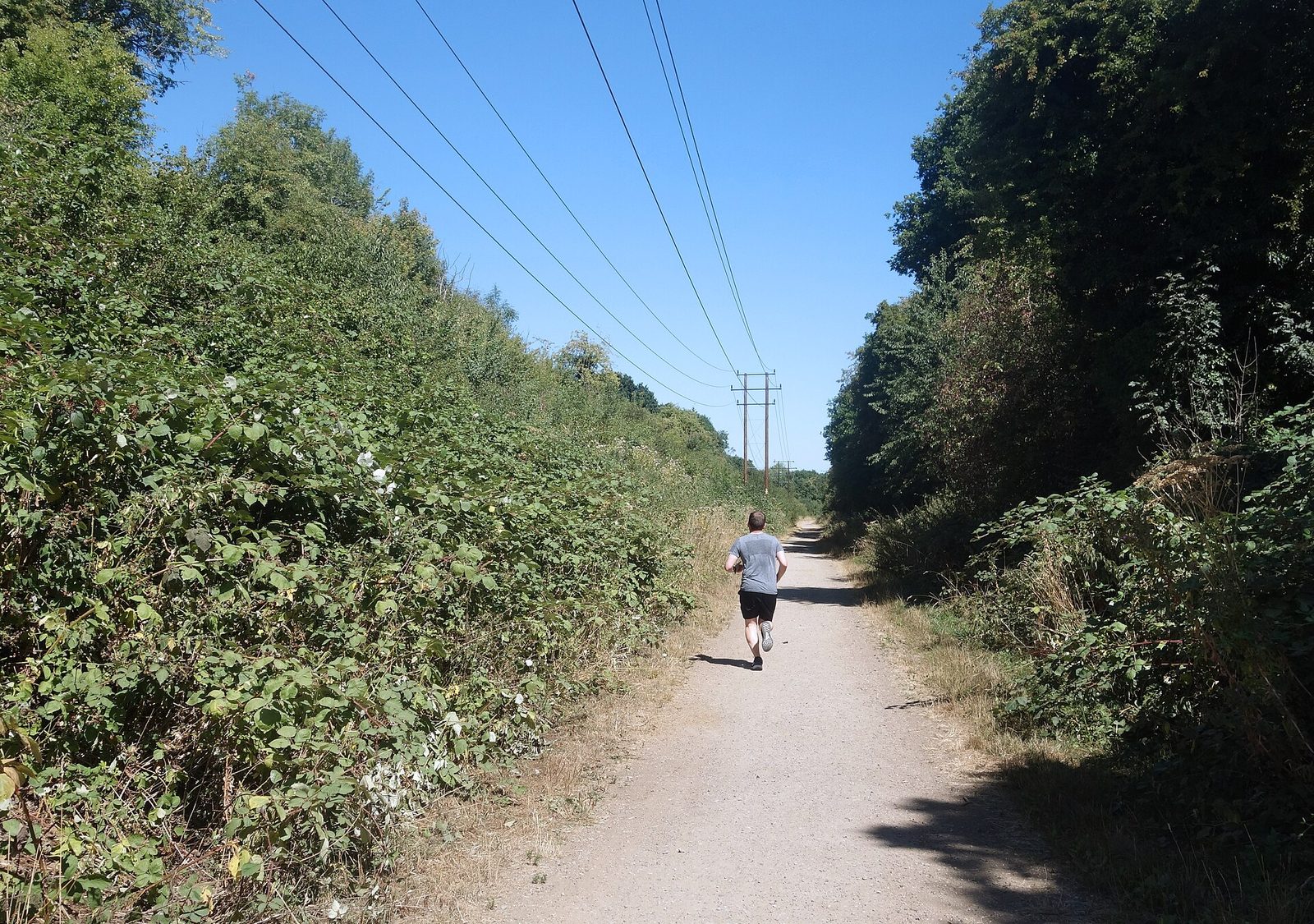
- Jogging along the old railway path, Ash, Surrey · Photo: Des Blenkinsopp, CC BY-SA 2.0 (Resized)
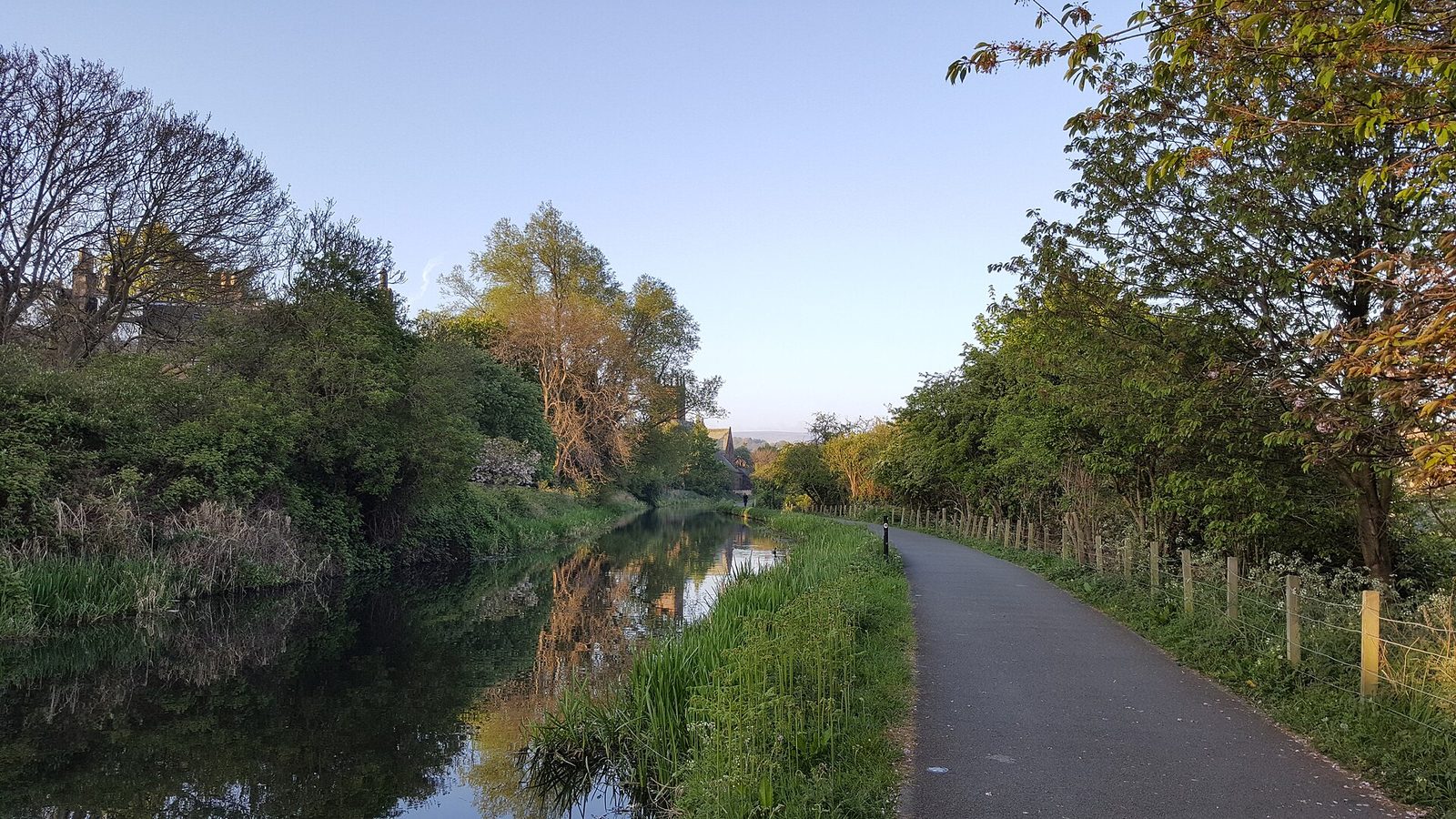
- Early morning on the Union Canal towpath, Edinburgh · Photo: Clive Nicholson, CC BY-SA 2.0 (Resized)
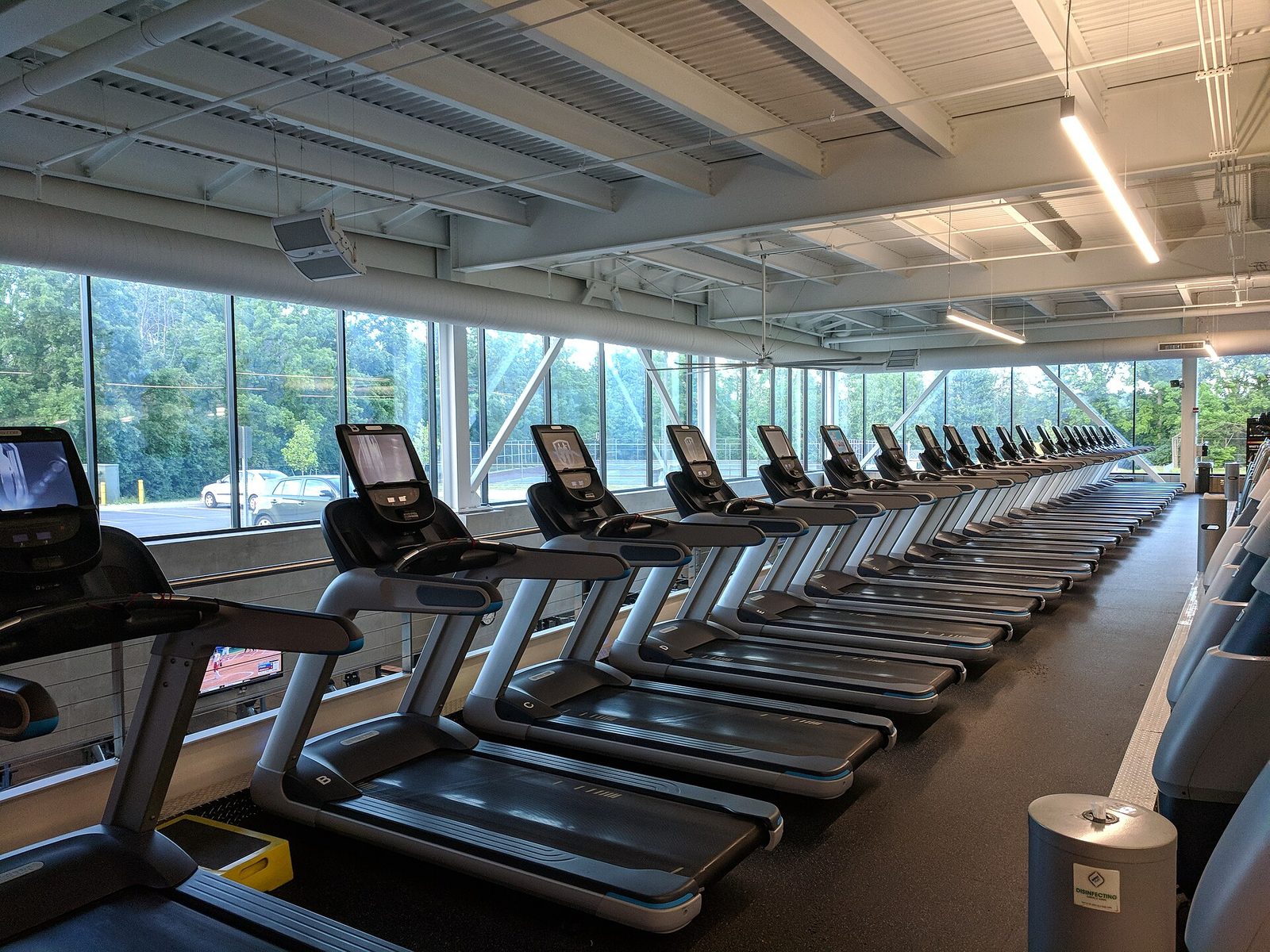
- Treadmills at the Champion Fitness Center, Jewish Community Center of Greater Rochester, New York · Photo: DanielPenfield, CC BY-SA 4.0 (Resized)
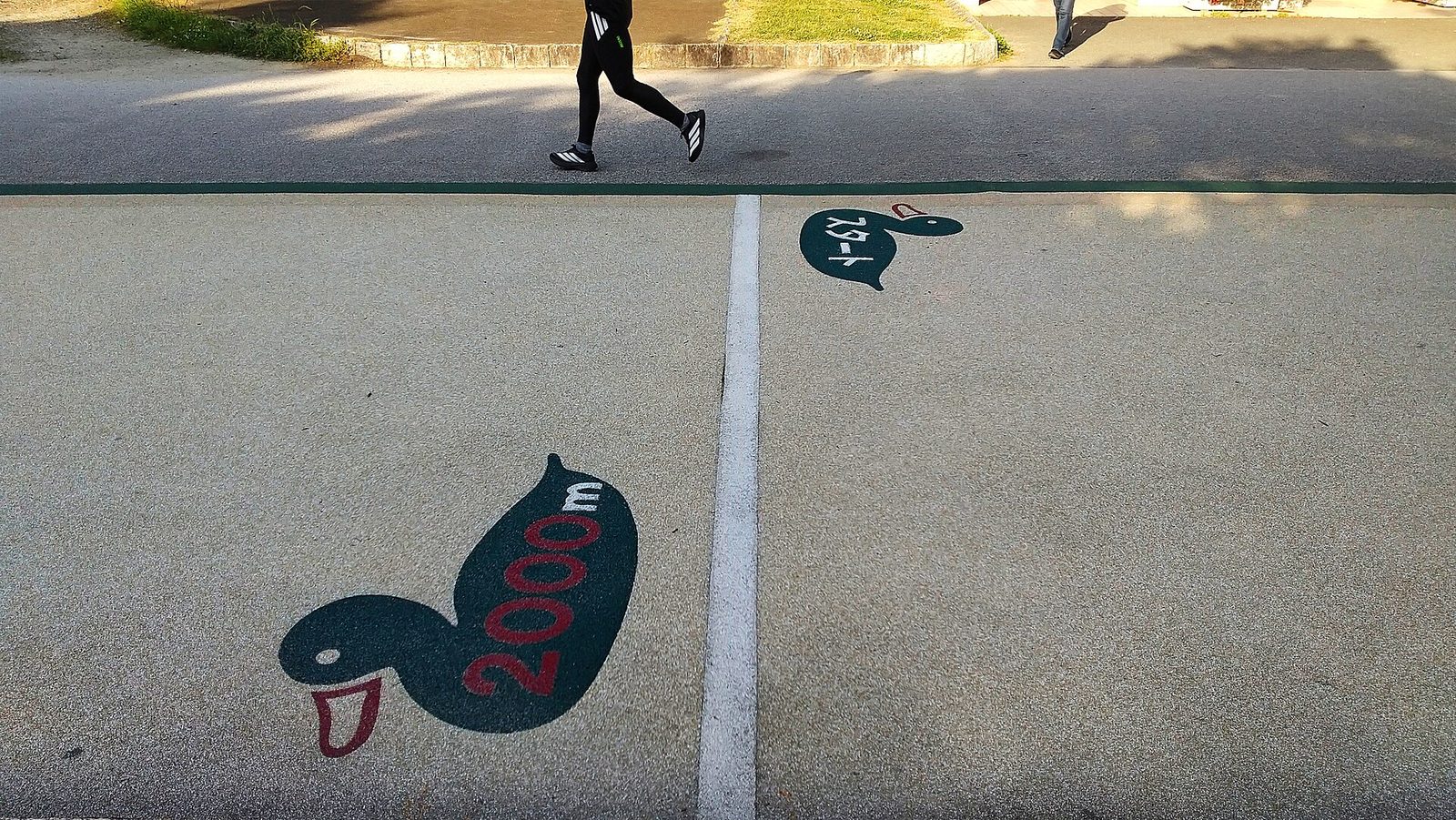
- The 2,000-metre mark on the Ōhori Park loop path, Fukuoka · Photo: Hirho, CC BY 4.0 (Resized)