 Haplo
Haplo
Half Marathon Training Plan: 12 Weeks, 3 to 5 Days a Week
Twelve weeks built around one long run that grows from 8 km to 15.6 km, with an easy run and one interval session every week, plus a second easy run and a short strength session when you have the days. Here's every session as Cinder ships it, how to lay out your week, how to fit in the race, and what the research says about building up.

This half marathon training plan takes 12 weeks at three to five days a week. Every week has one long run that grows from 8 km to 15.6 km by week 10, plus an easy run and one interval session; with more days you add a second easy run and a short strength session, and weeks 4, 8 and 12 are lighter. It’s the Build Up to a Half Marathon plan from Cinder, the workout tracker we make, which lays the sessions out on the days you pick and tracks every run.
Below is the plan exactly as the app ships it: all five sessions, every week’s long run, and the app’s own notes. In each session, the summary and the short note on each block are Cinder’s words; the effort label beside each run’s time, and the coaching cues and swaps under them, are ours. Around the plan is what a plan card can’t hold: how to lay out your week, how easy the easy running should be, how to fit in the race itself, and what research on runners preparing for a half marathon says about building up.
Who this half marathon plan is for
Runners who can already keep going for half an hour. Cinder’s description says the plan suits “someone already running comfortably for half an hour who wants a structure to follow rather than a distance to guess at”, and the app rates it Intermediate.
Half an hour is the entry point, though, not week 1. The first week has a 35-minute easy run and an 8 km long run, which Cinder estimates at 52 minutes using the 6:30 per km pace it assumes for its time estimates. If your longest recent run is around 30 minutes, that first long run is a big step up. A study of 5,205 runners’ Garmin data linked any run more than 10% longer than the longest of the previous 30 days to a higher rate of overuse injury (Schuster Brandt Frandsen et al., 2025). The long run’s own note allows walk breaks, so walk part of it if you need to, or spend a few weeks stretching your longest run towards 50 minutes before you start (our suggestion). Starting from scratch? Our couch to 5K plan gets you to 30 minutes first.
You need somewhere to run and, for the strength session, a pair of dumbbells. If you have known heart or blood vessel disease (including a past stroke), diabetes or kidney disease, or signs or symptoms of one, get medical advice before you start: those are among the factors the American College of Sports Medicine’s screening model weighs, along with how active you are now and how hard you plan to train (Riebe et al., 2015). If you’re coming back from an injury, check with a physio first.
How the 12-week half marathon schedule works
Every week runs the same sessions in the same order, and only the long run (and a plank hold) changes from week to week. Here’s the week as Cinder writes it:
- Easy Run: 35 minutes, easy enough to hold a conversation.
- Intervals: a 10-minute warm-up, six 3-minute hard repeats with 90 seconds easy between, and a 10-minute cool-down.
- Second Easy Run: 30 minutes, easy from the first step.
- Runner Strength: six exercises with dumbbells and bodyweight, about 35 minutes.
- Long Run: 8 km in week 1, growing to 15.6 km in week 10.
How many of those you do depends on how many days you pick. Cinder drops the least important sessions first and tells you which ones:
| Days a week | You do | Left out | Weekly time in Cinder, week 1 to week 10 |
|---|---|---|---|
| 3 | Easy Run, Intervals, Long Run | Second Easy Run, Runner Strength | 127 to 176 minutes |
| 4 | Those three plus the Second Easy Run | Runner Strength | 157 to 206 minutes |
| 5 | All five sessions | Nothing | 192 to 244 minutes |
Two spacing rules hold the week together: the long run takes your last training day of the week, and it should never sit next to the intervals. Cinder keeps the sessions in the plan’s order on whatever days you choose, and when your days break a rule it tells you rather than quietly reshuffling them. Only the long run and the plank hold grow with the weeks. The easy runs and the intervals are written so they don’t scale, so they’re the same in week 12 as in week 1.
How to follow the plan in Cinder
- Open the Plans tab. Build Up to a Half Marathon is the first plan Cinder features, so you’ll usually find it in the row of plans under the calendar. Otherwise tap See all: it heads the Start here row, sits under Running, and comes up if you search “half”.
- The plan’s page lists the five sessions and has a Week by week row from W1 to W12. Tap a week to see its focus line and how long each session runs; the three cutback weeks carry a small dot and the label Cutback week.
- Tap Start this plan and choose your days. The picker opens on five days (Monday, Tuesday, Wednesday, Friday and Saturday if your calendar week starts on a Monday), and of the chips for 3, 4 and 5 days, the 3- and 4-day ones show how many of the five sessions they keep (3 of 5 and 4 of 5). Underneath, Your first week lays the sessions out with their minutes, the week’s total and any warning about your days.
- Turn on Remind me on training days if you’d like a nudge (it starts at 6 pm), then tap Start.
- On the Home tab, tap +, then Add Widget, and add Today’s Plan. On a training day it shows the session with a button to start it, Start Long Run for example, along with an estimated time and, on a long-run day, that week’s distance. A run starts tracking straight away, with GPS and a Live Activity on your lock screen, and the session is ticked off when you end the run. Runner Strength opens as a lift with every set laid out and the weights left for you to fill in.
- Cinder doesn’t time the repeats or stop you at the long run’s distance. Set an interval timer on your watch for the 6 × 3 minutes, and keep an eye on the distance during the long run.
- If life gets in the way, Pause the plan from its card’s menu under See all, or swipe it in My Plans. When you resume, Cinder moves your start date on by the whole weeks it was paused, so you pick up the week you left, or the week after it if you resume at an earlier point in the week than when you paused. Start again from week 1 is in the same menu.
Twelve weeks built around one long run
Up to five sessions a week, always in the same order. Only two things change from week to week: the long run, which grows from 8 km in week 1 to 15.6 km in week 10, and the plank hold. Weeks 4, 8 and 12 are lighter, and week 12 is race week.
- Length
- 12 weeks
- Days a week
- 3 to 5
- Level
- Intermediate
- Kit
- Somewhere to run, Dumbbells
- Easy Run Relaxed, conversational running to bank time on your feet. 35 min
- Intervals A warm-up, a block of harder repeats, and a cool-down. 10 min + 20 min + 10 min · about 40 min
- Second Easy Run More easy volume, shorter than the first. 30 min
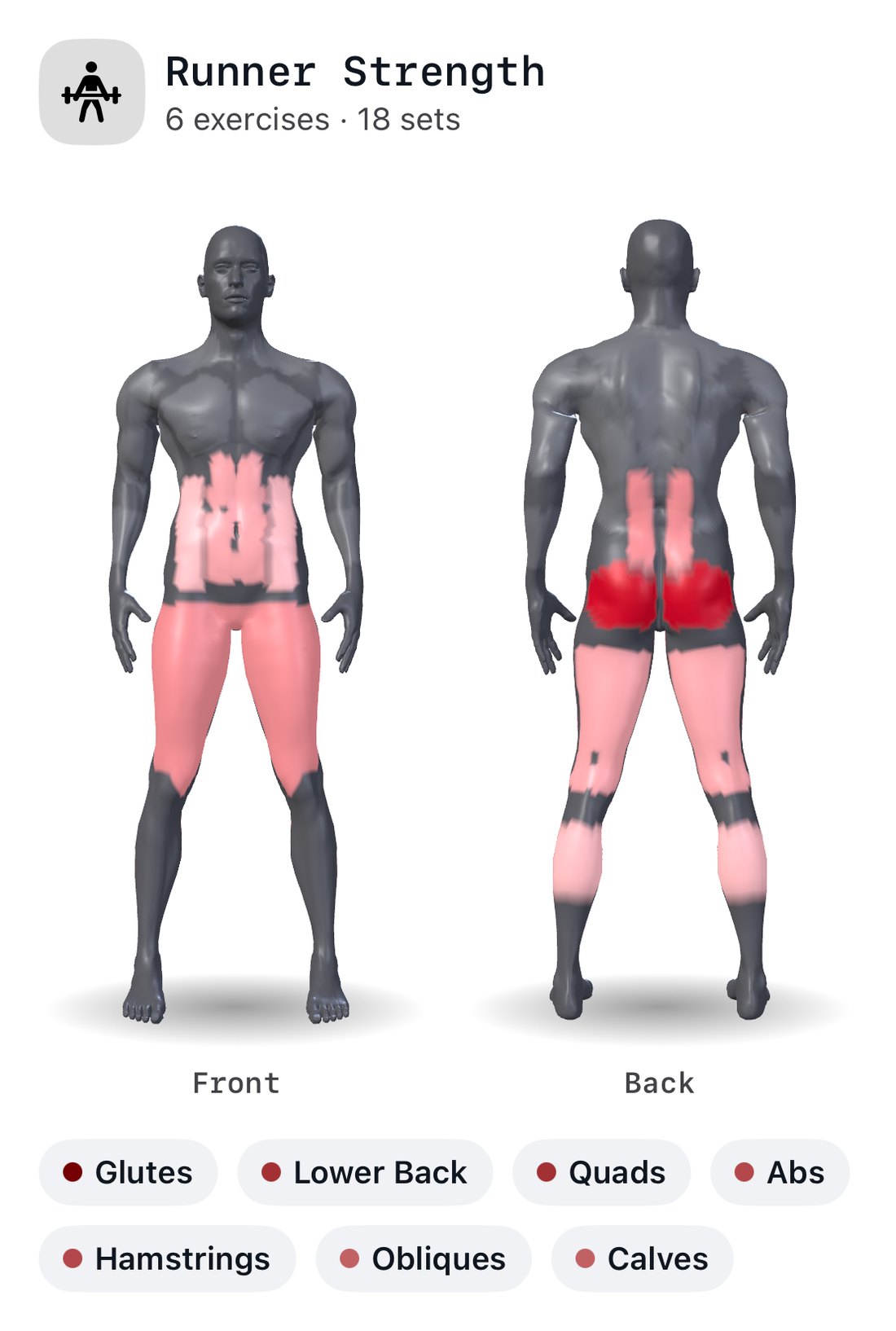
- Runner Strength Single-leg work and trunk bracing, kept short. 6 exercises · 18 sets · about 35 min
- Long Run The session the plan is built around. Even effort, start slow. 8 km · about 52 min
Picking your days
5 days: Cinder's first pick
- Mon · Easy Run
- Tue · Intervals
- Wed · Second Easy Run
- Fri · Runner Strength
- Sat · Long Run
What the day picker opens with when your calendar week starts on a Monday (with a Sunday start it’s Sunday to Friday, the same pattern a day earlier). Everything is in, and the long run is four days after the intervals. The one thing we’d change: Runner Strength lands the day before the long run.
5 days, long run on Sunday
- Mon · Easy Run
- Tue · Intervals
- Wed · Second Easy Run
- Fri · Runner Strength
- Sun · Long Run
Our suggestion if your race is on a Sunday and your calendar week starts on a Monday: the long run lives on Sundays, and Saturday’s rest keeps the leg work away from it. Cinder’s scheduler lays these days out exactly like this and raises no warning. (With a Sunday-start calendar, Sunday is the first day of the week, so the long run can’t go there.)
4 days a week
- Mon · Easy Run
- Tue · Intervals
- Thu · Second Easy Run
- Sat · Long Run
Cinder’s pick for four days with a Monday start. Runner Strength drops out, and the app says so: “You train fewer days than this plan writes, so Runner Strength is left out each week.” Any four days keep the plan’s rules: we ran all 35 possible picks through Cinder’s scheduler, with the week starting on Monday and on Sunday, and none put the intervals next to the long run or moved the long run off your last day. The only warning any of them gets is the one about Runner Strength.
3 days a week
- Mon · Easy Run
- Wed · Intervals
- Fri · Long Run
Cinder’s pick for three days with a Monday start (with a Sunday start it’s Sunday, Tuesday and Thursday, the same pattern a day earlier). The Second Easy Run and Runner Strength drop out. Choose your own days with care: in 15 of the 35 possible three-day picks, the intervals and the long run land on consecutive days, and Cinder warns you: “Intervals and Long Run land on back-to-back days. The plan would rather have a day between them.”
Easy Run
Relaxed, conversational running to bank time on your feet.
The first session of every week: 35 minutes at a pace you could chat at. It’s 35 minutes in week 1 and 35 minutes in week 12, because Cinder keeps the easy runs and the intervals out of the plan’s progression and lets only the long run (and Runner Strength’s plank hold) grow.
Run it by your breathing rather than by pace. If you could say a full sentence out loud at any moment, the pace is right. The NHS uses the same idea: at a moderate intensity, you can still talk, but not sing.

-
35 min · Talk test pace
Running
Easy enough to hold a conversation
Start slower than feels necessary and let the first ten minutes feel almost lazy. If talking gets hard, slow down: in a lab study of 16 volunteers, the point where speech first became difficult was almost exactly the ventilatory threshold, on a treadmill and on a bike (Persinger et al., 2004). Walk the steep hills if that’s what it takes to keep talking.
Swap A treadmill works just as well. Set the speed by the talk test, not by the number on the display.
Research: Persinger et al., 2004, Reed and Pipe, 2014
Intervals
A warm-up, a block of harder repeats, and a cool-down.
The one hard session of the week: a 10-minute warm-up, six 3-minute repeats at a hard effort with 90 seconds of easy running between them, and a 10-minute cool-down.
One thing the app’s numbers hide. The middle block is listed as 20 minutes, but six 3-minute repeats with five 90-second recoveries take 25½ minutes on the clock. Budget about 46 minutes for the session, not the 40 Cinder estimates. Like the easy runs, it stays the same for all 12 weeks, race week included (see Race week below).
Hard intervals have solid evidence behind them. In an eight-week study of 40 moderately trained men, 4-minute intervals at 90 to 95% of maximum heart rate, three times a week, raised VO2max more than the same total work run easy or at threshold (Helgerud et al., 2007). A meta-analysis of 28 studies found that both continuous training and interval training improve VO2max a lot, with intervals ahead by a small margin (Milanović et al., 2015). This plan asks for one session a week, so treat those as reasons to do it well, not as a forecast. Our VO2 max by age guide explains what the number means.

-
10 min · Easy, building
Running
Warm-up, gradually lifting the pace
Start at easy-run pace and lift it a little over the last few minutes, so the first repeat isn’t a shock.
-
20 min · Hard
Running
6 × 3 minutes hard, 90 seconds easy between
Hard but even: pick an effort you can hold for all six, so the last repeat matches the first. By breathing, this is the NHS’s vigorous effort, where you can’t say more than a few words without pausing for breath. Jog the 90 seconds between rather than stopping, and if the last two fall apart, start the first ones slower next week.
Swap On a treadmill, raise the speed for each repeat and drop to a jog for the recoveries. A track is handy but not needed: the repeats are timed, not measured.
Research: Helgerud et al., 2007, Milanović et al., 2015
-
10 min · Very easy
Running
Cool-down, very easy
Slow right down and finish at a walk if you like. The hard part is done.
Second Easy Run
More easy volume, shorter than the first.
Thirty more easy minutes, five fewer than the first. It’s the plan’s only supporting session, so it’s the first run to go: on a three-day week Cinder leaves it out, along with Runner Strength.
On the five days Cinder suggests, it falls the day after the intervals, so run it slower still if your legs can feel them. Easy running is where most of this plan’s time goes, which is how competitive endurance athletes tend to train: across descriptive studies, about 80% of their sessions are at low intensity (Seiler, 2010).
-
30 min · Talk test pace
Running
Easy from the first step
No build-up and no fast finish: easy from the first step to the last, as the note says. A run that feels almost too slow is doing its job.
Swap On a day when your legs feel beaten up, a 30-minute easy bike ride keeps the time without the impact (our suggestion, not the app’s).
Runner Strength
Single-leg work and trunk bracing, kept short.
The optional session, and you need five training days a week to get it: six exercises and 18 sets, with a pair of dumbbells. Cinder estimates 35 minutes, but that counts one side of the split squats and the bird dogs. Doing both sides at the app’s own 4 seconds a rep makes it about 39.
Is it worth the time? For running economy (how much energy a given pace costs you), probably. In five controlled trials with 93 highly trained middle- and long-distance runners, 8 to 12 weeks of lower-body strength and plyometric training, two or three times a week, had a large beneficial effect (Balsalobre-Fernández et al., 2016), and a 2018 review found running economy improved by 2 to 8% in most of the 20 studies that measured it, though not in all of them (Blagrove et al., 2018). This plan does it once a week, less often than the two or three sessions a week in those five trials.
For injuries the evidence is mixed. A meta-analysis of 25 trials across many sports found that strength training cut injuries to less than a third (Lauersen et al., 2014). But in a randomised study of 720 first-time marathon runners, a self-directed 10-minute strength routine three times a week did not reduce the overuse injuries that stopped people finishing: 7.1% against 7.3% (Toresdahl et al., 2020).
The plan has no rule about where this session sits, and on Cinder’s five-day pick it’s the day before the long run. A strength session can leave fatigue that takes the quality out of a run for several hours to days afterwards (Doma et al., 2017), so we’d put a rest day between them (see Picking your days).
-
3 × 10 · Rest 90 s
Goblet Squat

Hold one dumbbell upright against your chest, elbows tucked in. Sit down between your hips with your knees tracking over your toes, keep your chest up, and stand by pushing the floor away. Pick a weight that leaves two or three good reps in hand at ten.
Swap A kettlebell held the same way, or bodyweight squats with a slow three-second lowering if you have no weights.
-
3 × 10 · Rest 90 s
Dumbbell Romanian Deadlift

Dumbbells in front of your thighs, knees soft. Push your hips back and let the weights slide down your legs until your hamstrings stop you, around the knee for most people, then drive your hips forward to stand. Your back keeps the same shape the whole way down and up.
Swap Single-leg Romanian deadlifts with one dumbbell, or glute bridges with a dumbbell across your hips.
-
3 × 8 · Rest 90 s
Bulgarian Split Squat
Each side
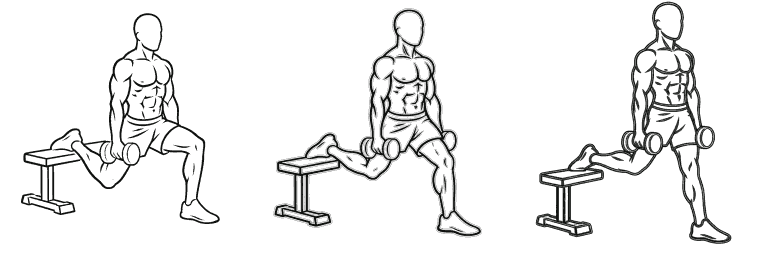
Rear foot on a bench behind you, front foot far enough forward that your front shin stays close to upright as you lower. Go down until your back knee nearly touches the floor, then drive up through the front foot. Do all eight on one leg, then switch. Running happens one leg at a time, and this is the plan’s single-leg strength work.
Swap Reverse lunges, or split squats with both feet on the floor.
-
3 × 15 · Rest 90 s
Calf Raise
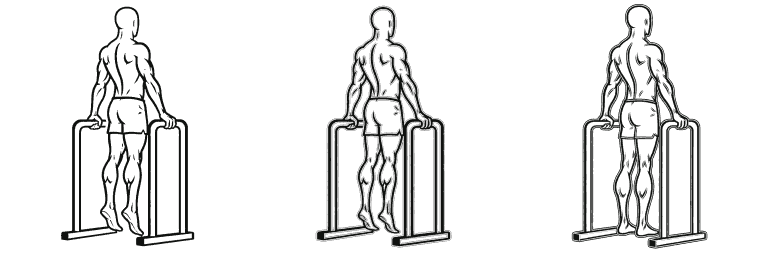
On the edge of a step, let your heels sink below it, pause, then rise as high as you can. In a modelling study of running from a jog to a flat-out sprint, the calf muscles (soleus and gastrocnemius) did more than any others to hold the body up at every speed up to 7 metres a second (Dorn et al., 2012).
Swap Single-leg calf raises holding a dumbbell, once 15 on two legs gets easy.
Research: Dorn et al., 2012
-
3 × 45 s · Rest 45 s
Plank

Forearms under your shoulders, glutes squeezed, ribs pulled down, and a straight line from head to heels. The hold grows with the plan’s weekly scale, as the long run does: 45 seconds in week 1, 88 in week 10 and 36 in race week. When your hips start to sag, the set is over.
Swap Side planks, splitting the time between the two sides.
-
3 × 10 · Rest 45 s
Bird Dog
Each side
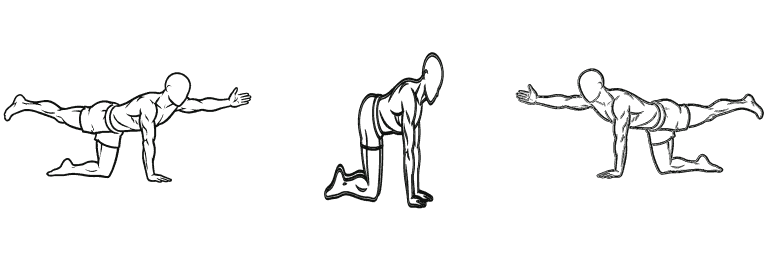
On all fours, reach one arm forward and the opposite leg back until both are level with your back, hold for a breath, and return slowly. Keep your hips square to the floor: the work is in not letting your body twist. In an EMG study of nine exercises, this one (there called the quadruped arm/lower extremity lift) worked gluteus maximus hard enough that the authors suggest it may help strengthen it (Ekstrom et al., 2007); another found it worked the internal oblique on the side of the raised arm and the back extensors on the other side the most (García-Vaquero et al., 2012).
Swap Dead bugs for the same reps, lying on your back.
Research: Ekstrom et al., 2007, García-Vaquero et al., 2012
Long Run
The session the plan is built around. Even effort, start slow.
The key session, and the one the plan keeps whatever else drops. It’s measured in distance: 8 km in week 1, growing most weeks to 15.6 km in week 10, with lighter weeks at 4, 8 and 12 (every distance is in the week list below). At the 6:30 per km pace Cinder uses for its estimates, that’s 52 minutes in week 1 and about 101 in week 10. Your own pace sets the real times.
It always takes your last training day of the week and should never sit next to the intervals: those are the plan’s two spacing rules. The note allows walk breaks, and they needn’t cost you much. In a randomised study of 42 non-elite marathon runners, those who used a run/walk strategy finished in a similar time to those who ran the whole way, and reported less muscle pain and fatigue afterwards (Hottenrott et al., 2016).

-
8 km · Easy, even effort
Running
Steady and even. Walk breaks are allowed.
Start at the easy end of your easy pace and keep the second half at the same effort as the first, slowing down if you need to. From week 5 the long run passes 70 minutes at Cinder’s estimate, which makes it the place to practise eating and drinking on the move: see Fuel for long runs and race day below.
Swap No long, safe route? Run laps of a shorter loop from home, which also makes it easy to stop if something hurts. On a treadmill, judge it by effort, not the display.
Research: Hottenrott et al., 2016, Thomas et al., 2016
The 12 weeks, week by week
-
Week 1
Settle in. Long run about 8 km.
Long Run: 8 km (5.0 mi), about 52 minutes at Cinder’s 6:30 per km. Plank 3 × 45 s. The other sessions stay the same all 12 weeks: Easy Run 35 minutes, Intervals 10 + 20 + 10, Second Easy Run 30.
-
Week 2
A little further. Long run about 9 km.
Long Run: 9.2 km (5.7 mi), about 60 minutes. Plank 3 × 52 s.
-
Week 3
Long run about 10 km.
Long Run: 10.4 km (6.5 mi), about 68 minutes. In kilometres, Cinder shows anything from 10 km up as a whole number, so the app says 10 km. Plank 3 × 59 s.
-
Week 4 · lighter
Cutback week. Long run drops back to about 7 km.
Long Run: 7.2 km (4.5 mi), about 47 minutes. Plank 3 × 41 s. The other runs don’t change, so only the long run and the plank get lighter.
-
Week 5
Long run about 11 km.
Long Run: 11.2 km (7.0 mi), about 73 minutes. Plank 3 × 63 s.
-
Week 6
Long run about 12 km.
Long Run: 12 km (7.5 mi), about 78 minutes. Plank 3 × 68 s.
-
Week 7
Long run about 13 km.
Long Run: 13.2 km (8.2 mi), about 86 minutes. Plank 3 × 74 s.
-
Week 8 · lighter
Cutback week. Long run about 9 km.
Long Run: 8.8 km (5.5 mi), about 57 minutes. Plank 3 × 50 s.
-
Week 9
The big one. Long run about 14 km.
Long Run: 14.4 km (8.9 mi), about 94 minutes. Plank 3 × 81 s.
-
Week 10
Longest run of the plan, about 15 km.
Long Run: 15.6 km (9.7 mi), about 101 minutes: the longest run of the plan, and the app rounds it to 16 km. Plank 3 × 88 s.
-
Week 11
Winding down. Long run about 12 km.
Long Run: 12 km (7.5 mi), about 78 minutes. Plank 3 × 68 s.
-
Week 12 · lighter
Race week. Keep it short and easy.
Long Run: 6.4 km (4.0 mi), about 42 minutes. Plank 3 × 36 s. The plan doesn’t put the race in your calendar: see Race week for how we’d fit it in.
How to run the plan
How easy the easy running should be
Easy enough to talk in full sentences, which is what Cinder’s own notes ask for. The talk test holds up: a review in a cardiology journal found it valid, reliable and practical for setting exercise intensity, in athletes, healthy adults and people with heart disease.
Most of this plan is easy on purpose. With 18 minutes of hard repeats a week, about one minute of running in ten is hard (8 to 15%, depending on the week and how many days you run; our arithmetic from Cinder’s minutes). That’s close to how competitive endurance athletes train, with about 80% of sessions at low intensity, and there’s trial evidence for it. In a five-month trial with 12 sub-elite runners, those who did about 80% of their training below the first threshold improved their time in a 10.4 km cross-country race more than those who did about 67% there, with the same small dose of hard running (Esteve-Lanao et al., 2007). In 30 recreational runners over 10 weeks, the mostly easy group improved its 10 km time by 5.0% and the group with more moderate running by 3.6%, a difference that wasn’t statistically significant (Muñoz et al., 2014).
If you’d like heart-rate numbers for easy, our zone 2 guide explains how to find your range.
Fuel for long runs and race day
The 2016 joint position from the American College of Sports Medicine, the Academy of Nutrition and Dietetics and Dietitians of Canada sets out carbohydrate by how long you’re going (Thomas et al., 2016):
- Under 45 minutes: none needed.
- 45 to 75 minutes of hard effort: small amounts, including a carbohydrate mouth rinse.
- 1 to 2.5 hours: 30 to 60 g an hour.
- Before anything over an hour: 1 to 4 g per kg of body weight, eaten 1 to 4 hours beforehand.
The same position notes that losing more than 2% of your body weight as fluid can hurt aerobic performance, and that for events over 90 minutes, carbohydrate loading (10 to 12 g per kg a day for the 36 to 48 hours before) is an option. It also says to practise until you find a plan your gut is happy with, and the long runs from week 5 on are where to do that. For a plan built around you, it recommends a registered dietitian.
Race week
Cinder’s week 12 says “Race week. Keep it short and easy.” The long run drops to 6.4 km, but the plan doesn’t add the race to your calendar, and the easy runs and the intervals stay at full length.
Here’s what the research on tapering suggests. A meta-analysis of 27 studies in competitive athletes found the best results from a taper of about two weeks, with training volume cut by 41 to 60% while intensity and frequency stay the same (Bosquet et al., 2007). This plan’s last two weeks are gentler than that: on four days, the weekly minutes in weeks 11 and 12 are 11% and 29% below week 10 (our arithmetic from Cinder’s estimates).
Our suggestions, not the app’s:
- Run the race in place of week 12’s long run. If race day falls the day after your usual long-run day, skip that week’s long run.
- Keep the intervals in race week for the speed, but run three or four repeats instead of six.
- Trim the easy runs to 20 or 25 minutes, and keep the session days you’re used to.
- Skip Runner Strength in race week, so your legs are fresh on the day.
When a week goes wrong
If you have to drop something, follow the plan’s own order of importance, the same one Cinder uses when you train fewer days: the Long Run is the key session; the Easy Run and the Intervals are core sessions; the Second Easy Run is supporting; Runner Strength is optional.
Our suggestions: don’t make up a missed session by doubling up the next day. If you miss most of a week, repeat it rather than jumping to a longer long run. If you’re ill or away for a while, Pause the plan in Cinder, which moves your start date on by the whole weeks it was paused when you resume.
Soreness, or something more?
Expect some aches as the long run grows, and take pain seriously. In a study that followed 261 runners through 14 weeks of preparation for a half marathon, 21.5% picked up a running injury (Damsted et al., 2019).
One injury to know about is a bone stress injury. The American Academy of Orthopaedic Surgeons says it begins as discomfort in a specific spot along a bone, often 3 to 4 weeks after starting a new exercise routine, and can progress to pain with walking and aching at night. Its advice: don’t exercise through the pain, and see a doctor as soon as possible if you think you have one.
How fast should you build up for a half marathon?
Gradually, and with no single run far longer than you’re used to. The research is thin, but it points at sudden jumps rather than at any fixed weekly percentage.
- The 10% rule didn’t prevent injuries in a trial. When 532 new runners preparing for a 6.7 km event were given either a standard 8-week programme or a gentler 13-week one built on the 10% rule, the injury rates were almost identical: 20.3% and 20.8% (Buist et al., 2008).
- Big weekly jumps may matter. In 874 new runners, those who increased their weekly distance by more than 30% over two weeks had more of the injuries linked to distance than those who increased it by less than 10%, though the difference wasn’t statistically certain (Nielsen et al., 2014). In the half marathon study above, runners who raised their weekly distance by 20 to 60% had more injuries 21 days in than those who raised it by less than 20%; by days 56 and 98 the difference was no longer statistically significant (Damsted et al., 2019).
- Single long runs matter most in the newest data. A study that followed 5,205 runners’ Garmin data for 18 months found a higher rate of overuse injury after any run more than 10% longer than the longest run of the previous 30 days, and no link with week-to-week changes (Schuster Brandt Frandsen et al., 2025).
These are mostly observational studies, and a 2018 review found the evidence tying training changes to injury very limited (Damsted et al., 2018). Here’s how Cinder’s plan compares, by our arithmetic from the app’s own numbers:
| What changes | How much |
|---|---|
| Weekly minutes, each new high | 2 to 6% above the previous high |
| Weekly minutes, the week after a cutback | 14 to 28% up on the cutback week, 2 to 5% above the previous high |
| Long run, weeks 2 and 3 | 15% and 13% longer than the longest before |
| Long run, weeks 5 to 10 | 7 to 10% longer each time |
| Race day | 21.1 km, 35% longer than the 15.6 km week 10 run |
So the plan’s long runs meet the 2025 study’s 10% line from week 5, but not in weeks 2 and 3, and not in week 1 if your longest recent run is around half an hour. What we’d take from it: walk part of the early long runs if you need to, don’t add runs or stretch the long run beyond the plan, and treat race day as the one deliberate exception, started slowly.
Half marathon training FAQ
How long does it take to train for a half marathon?
This plan takes 12 weeks, from a starting point of running about half an hour comfortably. If you can’t do that yet, start with a walk-run plan such as our couch to 5K plan, then build your longest run towards 50 minutes before week 1 (our suggestion).
How many days a week should I run for a half marathon?
This plan works on three, four or five days. Three gives you the Easy Run, the Intervals and the Long Run; four adds the Second Easy Run; five adds Runner Strength. The long run is the one session to protect, and Cinder keeps it whatever you pick.
How long should my longest run be before a half marathon?
In this plan, 15.6 km (9.7 miles) in week 10, about three quarters of the 21.0975 km race distance set by World Athletics. It never asks you to run the full distance before race day, and it brings the long run back down to 12 km and then 6.4 km in the last two weeks.
Can I walk during a half marathon?
Yes. The plan’s long run allows walk breaks, and in a randomised marathon study, runners who mixed running and walking finished in a similar time to those who ran throughout, with less muscle pain and fatigue afterwards (Hottenrott et al., 2016). Check your race’s cut-off time before you plan on it.
What should I eat during a half marathon?
If you’ll be running for between one and two and a half hours, the sports nutrition guideline is 30 to 60 g of carbohydrate an hour, from drinks, gels or ordinary food (Thomas et al., 2016). Try it on your long runs first rather than on race day.
Is this half marathon plan OK for beginners?
For a first half marathon, yes, if you already run: Cinder rates it Intermediate and describes it as suiting “someone already running comfortably for half an hour”. If you don’t run yet, start with a walk-run plan. If you have known heart or blood vessel disease (including a past stroke), diabetes or kidney disease, or signs or symptoms of one, get medical advice first: those are the factors, along with how active you are and how hard you plan to train, that the American College of Sports Medicine’s screening model uses (Riebe et al., 2015).
How we made this
The plan is Cinder's Build Up to a Half Marathon (plan id half-marathon-build), copied from WorkoutPlanCatalog.swift in the app's source. Session names, summaries, priorities, the five sessions' blocks and lifts with their sets, reps, rest and notes, the two spacing rules and all 12 week focus lines are verbatim, and we changed nothing in the plan. The effort labels beside each run's time (such as Talk test pace, Hard and Very easy) are ours, not the app's. Our suggestions (the Sunday long run, a rest day between Runner Strength and the long run, race week, missed sessions) are labelled as ours.
The numbers come from running the app's own code. In October 2026 we compiled Cinder's WorkoutPlanModels.swift, WorkoutPlanCatalog.swift and WorkoutPlanScheduler.swift with stand-ins for the app's colours and unit labels, and printed every week. The long run is written as 8 km and scales with each week's volume factor (1, 1.15, 1.3, 0.9, 1.4, 1.5, 1.65, 1.1, 1.8, 1.95, 1.5 and 0.8), rounded to the nearest 50 m; the plank's 45 seconds scales the same way, rounded to the second. The timed runs are written so they don't scale, and sets and reps never do. Session times are Cinder's estimate: 4 seconds a rep plus the written rest for lifts, the written time plus the written rest for timed blocks (the plank's 45 seconds of rest count; the timed runs have none), and 6:30 per km for distance. Miles use the app's 1,609.34 m.
The schedules are the scheduler's real output. We ran every possible three-, four- and five-day pick with the week starting on Monday and on Sunday: 15 of the 35 three-day picks put the intervals and the long run on consecutive days, and no four- or five-day pick breaks a rule. The warnings quoted are printed by the same code, word for word. The percentages in the build-up table and the taper figures are our arithmetic from those outputs, using Cinder's own session estimates, which count the Intervals as 40 minutes; the share of hard running uses 25½ minutes for the interval block.
The steps for following the plan in Cinder (the Plans tab, See all, the Week by week chips, the setup sheet and its defaults, reminders, the Today's Plan card, how runs and lifts start, ticking off, pausing) were checked against the app's source. A run started from the Today's Plan card is tracked with GPS and a Live Activity with no distance or time target, and nothing in the app times the interval repeats.
The muscle map is Cinder's own. We rendered Runner Strength in a developer build of the app, with the same 3D muscle map and the same arithmetic it uses after you log a workout: every set counts in full for an exercise's main muscles and half for the muscles that assist, and the shading runs from grey (not worked) to deep red (the session's hardest-worked muscle). Two things to know. Cinder's lookup table has no entry for the bird dog (the app asks its on-device model about names it doesn't recognise), so for this render we added one, with the glutes and lower back as the main movers and the obliques assisting, based on the EMG studies cited under the exercise. And the map counts lifting sets only, so the runs don't appear on it: a map of the whole five-day week would look exactly like this one, which is why the page shows it once.
The exercise drawings are the ones Cinder shows next to each exercise, by Bryl Lim from his Workout Guide set (CC BY-SA 4.0), set side by side here in movement order.
Every study cited was read on PubMed in October 2026, and our claims stay within what the abstracts say; for the 2016 sports nutrition position and the 2015 exercise screening recommendations we read the full texts. The race distance is from World Athletics, the effort descriptions from the NHS and the bone stress injury advice from AAOS OrthoInfo, all read on their own sites the same month. The photos are from Wikimedia Commons and are credited on this page. This is general training information, not medical advice.
References
- World Athletics. Half Marathon (discipline page).
- Damsted C, Parner ET, Sørensen H, Malisoux L, Hulme A, Nielsen RØ. (2019). The association between changes in weekly running distance and running-related injury: preparing for a half marathon. Journal of Orthopaedic & Sports Physical Therapy, 49(4), 230-238.
- Schuster Brandt Frandsen J, Hulme A, Parner ET, et al. (2025). How much running is too much? Identifying high-risk running sessions in a 5200-person cohort study. British Journal of Sports Medicine, 59(17), 1203-1210.
- Buist I, Bredeweg SW, van Mechelen W, Lemmink KA, Pepping GJ, Diercks RL. (2008). No effect of a graded training program on the number of running-related injuries in novice runners: a randomized controlled trial. American Journal of Sports Medicine, 36(1), 33-39.
- Nielsen RØ, Parner ET, Nohr EA, Sørensen H, Lind M, Rasmussen S. (2014). Excessive progression in weekly running distance and risk of running-related injuries: an association which varies according to type of injury. Journal of Orthopaedic & Sports Physical Therapy, 44(10), 739-747.
- Damsted C, Glad S, Nielsen RO, Sørensen H, Malisoux L. (2018). Is there evidence for an association between changes in training load and running-related injuries? A systematic review. International Journal of Sports Physical Therapy, 13(6), 931-942.
- Seiler S. (2010). What is best practice for training intensity and duration distribution in endurance athletes? International Journal of Sports Physiology and Performance, 5(3), 276-291.
- Esteve-Lanao J, Foster C, Seiler S, Lucia A. (2007). Impact of training intensity distribution on performance in endurance athletes. Journal of Strength and Conditioning Research, 21(3), 943-949.
- Muñoz I, Seiler S, Bautista J, España J, Larumbe E, Esteve-Lanao J. (2014). Does polarized training improve performance in recreational runners? International Journal of Sports Physiology and Performance, 9(2), 265-272.
- Persinger R, Foster C, Gibson M, Fater DC, Porcari JP. (2004). Consistency of the talk test for exercise prescription. Medicine & Science in Sports & Exercise, 36(9), 1632-1636.
- Reed JL, Pipe AL. (2014). The talk test: a useful tool for prescribing and monitoring exercise intensity. Current Opinion in Cardiology, 29(5), 475-480.
- Helgerud J, Høydal K, Wang E, et al. (2007). Aerobic high-intensity intervals improve VO2max more than moderate training. Medicine & Science in Sports & Exercise, 39(4), 665-671.
- Milanović Z, Sporiš G, Weston M. (2015). Effectiveness of high-intensity interval training (HIT) and continuous endurance training for VO2max improvements: a systematic review and meta-analysis of controlled trials. Sports Medicine, 45(10), 1469-1481.
- Balsalobre-Fernández C, Santos-Concejero J, Grivas GV. (2016). Effects of strength training on running economy in highly trained runners: a systematic review with meta-analysis of controlled trials. Journal of Strength and Conditioning Research, 30(8), 2361-2368.
- Blagrove RC, Howatson G, Hayes PR. (2018). Effects of strength training on the physiological determinants of middle- and long-distance running performance: a systematic review. Sports Medicine, 48(5), 1117-1149.
- Lauersen JB, Bertelsen DM, Andersen LB. (2014). The effectiveness of exercise interventions to prevent sports injuries: a systematic review and meta-analysis of randomised controlled trials. British Journal of Sports Medicine, 48(11), 871-877.
- Toresdahl BG, McElheny K, Metzl J, Ammerman B, Chang B, Kinderknecht J. (2020). A randomized study of a strength training program to prevent injuries in runners of the New York City Marathon. Sports Health, 12(1), 74-79.
- Doma K, Deakin GB, Bentley DJ. (2017). Implications of impaired endurance performance following single bouts of resistance training: an alternate concurrent training perspective. Sports Medicine, 47(11), 2187-2200.
- Dorn TW, Schache AG, Pandy MG. (2012). Muscular strategy shift in human running: dependence of running speed on hip and ankle muscle performance. Journal of Experimental Biology, 215(11), 1944-1956.
- Ekstrom RA, Donatelli RA, Carp KC. (2007). Electromyographic analysis of core trunk, hip, and thigh muscles during 9 rehabilitation exercises. Journal of Orthopaedic & Sports Physical Therapy, 37(12), 754-762.
- García-Vaquero MP, Moreside JM, Brontons-Gil E, Peco-González N, Vera-Garcia FJ. (2012). Trunk muscle activation during stabilization exercises with single and double leg support. Journal of Electromyography and Kinesiology, 22(3), 398-406.
- Hottenrott K, Ludyga S, Schulze S, Gronwald T, Jäger FS. (2016). Does a run/walk strategy decrease cardiac stress during a marathon in non-elite runners? Journal of Science and Medicine in Sport, 19(1), 64-68.
- Bosquet L, Montpetit J, Arvisais D, Mujika I. (2007). Effects of tapering on performance: a meta-analysis. Medicine & Science in Sports & Exercise, 39(8), 1358-1365.
- Thomas DT, Erdman KA, Burke LM. (2016). American College of Sports Medicine joint position statement: nutrition and athletic performance. Medicine & Science in Sports & Exercise, 48(3), 543-568.
- Riebe D, Franklin BA, Thompson PD, et al. (2015). Updating ACSM's recommendations for exercise preparticipation health screening. Medicine & Science in Sports & Exercise, 47(11), 2473-2479.
- NHS. Physical activity guidelines for adults aged 19 to 64.
- American Academy of Orthopaedic Surgeons, OrthoInfo. Stress fractures.
Image credits
- Runners near the halfway point of the Mulberry Island Half Marathon, Fort Eustis, Virginia · Photo: Staff Sgt. Natasha Stannard, U.S. Air Force, Public domain (Cropped and resized)
- Stony Brook Rail Trail, Westford, Massachusetts · Photo: John Phelan, CC BY-SA 4.0 (Cropped and resized)
- Running track at the Otaniemi sports field, Espoo, Finland · Photo: JIP, CC BY-SA 4.0 (Cropped and resized)
- Southwick Rail Trail continuing as the Columbia Greenway Rail Trail, Westfield, Massachusetts · Photo: John Phelan, CC BY 4.0 (Cropped and resized)
- Exercise drawings (the same ones Cinder shows) · Drawings: Bryl Lim, from Workout Guide, CC BY-SA 4.0 (resized and re-encoded for Cinder; recolored and set side by side here)