 Haplo
Haplo
Using Your Phone Before Bed: Why It Keeps You Up
Blue light gets the blame, but the studies point to two bigger culprits: the time a phone quietly takes from your night, and what's on the screen. Here's what the research found, and a nightly cutoff built around it.
Most of us take a phone to bed, and most advice about it stops at blue light: turn on Night Shift, maybe buy orange glasses, keep scrolling. The research is more useful than that. Screen light can nudge your body clock, but how much depends on how bright the screen is and how long you look at it. The bigger costs of using your phone before bed are the time it takes and what’s on it, and no filter touches either.
Below is what the studies show, which fixes hold up, and a cutoff schedule you can set up tonight. We make Barrier, an app blocker for iPhone, but the schedule works in any blocker or in the iPhone’s own settings. This is general information, not medical advice: if you often struggle to fall or stay asleep, or feel sleepy by day despite enough time in bed, talk to a doctor.
Does using your phone before bed hurt your sleep?
On average a little, and more for some people than others.
In the National Sleep Foundation’s 2011 poll of 1,508 Americans, 9 in 10 used some kind of technology in the hour before bed. The more interactive devices they used in that hour (computers, phones, games consoles), the more often they reported trouble falling asleep and unrefreshing sleep. Passive ones, like the TV and music players, showed no such link. In a 2022 online survey of 2,010 US adults commissioned by the American Academy of Sleep Medicine (AASM), 80 percent said they had lost sleep staying up past their bedtime on social media.
The last half hour seems to matter on its own. Among 1,763 US adults aged 19 to 32, those who often checked social media in the 30 minutes before bed had 1.62 times the odds of more disturbed sleep than those who rarely did, even allowing for their total social media use.
Two caveats. Most of this is association, and the arrow can point both ways: a 2024 review argues that people who can’t sleep may reach for a phone to pass the time or settle their mood. And when experiments change phone habits, the effects are real but modest: minutes rather than hours. Minutes add up, though. Ten a night is more than an hour a week.
Why your phone keeps you up at night
That review sorts the ways technology can disturb sleep into four: bright light, arousal, disruption in the night, and displacement, where the phone simply takes time you’d otherwise spend asleep. Here they are in the order we’d tackle them.
1. It takes time you meant to spend asleep
A feed has no last page, so “five more minutes” has no natural end. A survey of 338 adults aged 18 to 25 found that sleep slips away in two steps: people put off going to bed, then put off trying to sleep once they’re there. That second gap averaged 39 minutes, and people whose gap ran over an hour were 9.3 times more likely to be rated poor sleepers than those who tried to sleep straight away. Of everything the survey asked about, only media use before bed was linked to the length of that gap. No light filter touches this. A fixed cutoff does.
2. What’s on the screen keeps your mind switched on
Much of what’s on a phone asks for a reaction: a reply, a swipe, another episode. A small lab study pulled content and light apart. Seven young men each did four late-night sessions, playing an exciting computer game or doing a simple, undemanding task, on a bright screen or a dark one, before going to bed at 2 am. After the game they felt less sleepy, took longer to fall asleep and got less REM sleep. The bright screen raised their heart rate but had no measurable effect on their sleep. Seven people is a tiny sample, so treat it as a clue. It fits the survey finding, though, that interactive use, rather than screens as such, goes with trouble falling asleep.
3. The light, which matters less than you’ve heard
The light effect is real. In the best-known study, 12 young adults read on an iPad at full brightness for about four hours before bed in an otherwise very dim room, on five evenings in a row, and read a printed book on five others. After the iPad evenings, they took nearly 10 minutes longer to fall asleep (about 26 minutes against 16), their evening melatonin was suppressed by 55 percent, their body clocks ran more than 90 minutes later, they got about 12 minutes less REM sleep, and they were sleepier the next morning.
Look at the dose, though: four hours, full brightness, near darkness. When 13 people used tablets at the highest brightness, one hour didn’t measurably suppress their melatonin; two hours did.
Your room lights count too. When 55 people aged 18 to 30 spent five evening hours under different light levels, melatonin was halved at about 25 lux on average, below the 30 to 300 lux the authors say people now spend hours in each evening. Sensitivity varied more than tenfold from person to person. For scale, the iPad in the reading study delivered about 32 lux to the eyes.
Expert recommendations from 2022 suggest keeping light at the eye to no more than 10 lux melanopic EDI (a measure weighted toward the eye cells that set the body clock) for at least three hours before bed, and the bedroom below 1 lux. In practice that means dim, warm lamps instead of overhead lights in the evening, and your phone’s brightness turned down.
4. It wakes you up
In the 2011 poll, 22 percent of people slept with their phone’s ringer on in the bedroom, and 10 percent were woken by their phone at least a few nights a week, rising to 20 percent of adults under 30. That’s the easiest one to fix: silence the phone, or better, charge it somewhere else.
Does Night Shift or blue-light blocking help?
Night Shift moves your screen toward warmer colours, by default from sunset to sunrise. It’s fine to leave on, but the evidence that it, or a pair of blue-light glasses, improves sleep is thin.
- Night Shift alone may not protect melatonin. In a lab study of 12 young adults using iPads, melatonin suppression didn’t differ between a warmer and a cooler Night Shift setting. The authors concluded that changing a screen’s colour without lowering its brightness may not be enough.
- In a week-long trial, it made no difference. 167 students aged 18 to 24 were randomly assigned to use their iPhone in the hour before bed with Night Shift on, off, or not at all for seven nights, wearing sleep-tracking wristbands. Overall, there were no significant differences. In an exploratory follow-up of those averaging over 6.8 hours of sleep, the no-phone group slept more efficiently and woke less than the Night Shift group.
- Blue-light glasses are unproven for sleep. A 2023 Cochrane review found six trials, with 148 people between them, that measured sleep quality. Three found better sleep with the lenses, three found no difference, and the evidence was too uncertain to say whether they help.
So filters work on the smallest part of the problem and do nothing about the time or the content. Lowering the brightness is the better fix for the light. For the rest, the phone has to go down.
How long before bed should you stop using your phone?
At least 30 minutes, and up to an hour. The AASM’s patient site says to turn off electronic devices at least 30 minutes before bedtime, and its 2022 survey release suggested 30 minutes to an hour.
The one randomised trial of a bedtime phone cutoff we found used 30 minutes. Thirty-eight university students who slept poorly and habitually used their phones at bedtime were split into two groups, and one group stopped using the phone 30 minutes before bed for four weeks. That group fell asleep about 12 minutes faster, slept about 18 minutes longer and felt less wound up before sleep, with better mood and working memory too. It was a small pilot that relied on sleep diaries, so the exact numbers are soft, but they point the same way as everything above.
How to work out your phone cutoff
Work backwards from the time you get up:
- Fix your wake-up time. The first of the AASM’s healthy sleep habits is to get up at the same time every day, even on weekends.
- Count back your sleep. Adults should sleep 7 or more hours a night on a regular basis, according to a joint consensus statement from the AASM and the Sleep Research Society. We use 7.5 hours.
- Add the time you take to drift off. We use 15 minutes. That gives your lights-out time.
- Take off 30 or 60 minutes. That’s your phone cutoff.
| Wake up | Lights out | Phone off (30 min) | Phone off (60 min) |
|---|---|---|---|
| 6:00 am | 10:15 pm | 9:45 pm | 9:15 pm |
| 6:30 am | 10:45 pm | 10:15 pm | 9:45 pm |
| 7:00 am | 11:15 pm | 10:45 pm | 10:15 pm |
| 7:30 am | 11:45 pm | 11:15 pm | 10:45 pm |
| 8:00 am | 12:15 am | 11:45 pm | 11:15 pm |
If you get up at 7:00 am, lights out is 11:15 pm, so the phone goes down at 10:45 pm, or at 10:15 pm on the 60-minute version.
A phone cutoff schedule you can set up tonight
Here’s the plan as one schedule, using the 7:00 am example. It works in any app blocker that lets a schedule run past midnight, and most of it works in the iPhone’s own settings (see below).
| Setting | What to choose |
|---|---|
| Name | Phone curfew |
| Starts | Your cutoff: 10:45 pm |
| Ends | Your wake-up time: 7:00 am |
| Days | All seven |
| Lock | The apps you lose time to: social media, video, games, news, shopping, work email |
| Keep open | Phone, Messages, Clock, and one audio app if you fall asleep to something |
| Exceptions | Possible, but slow to get and short: a wait first, an automatic relock after |
Run it until morning. A lock that ends at midnight leaves the phone within reach for the rest of the night. If you can’t fall asleep, the AASM’s advice is to get out of bed after 20 minutes and do something quiet in low light, and it’s firm that this shouldn’t mean electronics.
Lock the pull, not the phone. Keep calls, messages from people who might need you, your alarm and anything you rely on for your health. Apple’s own guide suggests keeping family members and the Health app available for emergencies. An audiobook or podcast with the screen off is a fair compromise: in the 2011 poll, passive devices like music players weren’t tied to trouble falling asleep.
Make exceptions slow and short. Sometimes you’ll need the phone after the cutoff: a boarding pass, a late taxi. A lock with no way out is one you’re likely to switch off the first time it gets in the way, and one you can dismiss with a tap barely counts. A short wait before an unlock and an automatic relock a few minutes later keep exceptions rare.
Charge it away from the bed. The AASM suggests leaving your phone in another room and using an alarm clock instead, and if it stays in the bedroom, turning off push notifications and sounds. It also suggests filling the time you get back with something you look forward to, like a warm bath, a book or journaling.
Setting it up on iPhone without an app
- Sleep Focus. In the Health app, set up a sleep schedule and set Wind Down to 30 or 60 minutes (it can start anywhere from 15 minutes to 3 hours before bedtime). Your Sleep Focus begins when Wind Down does and can filter out notifications and calls, so the phone goes quiet at your cutoff.
- Screen Time Schedules. In iOS 27, a Screen Time Schedule splits each day into time windows, and you choose which Time Allowance categories, such as Social Media or Games, are available in each. Apps and contacts under Always Allowed stay available regardless.
Our guide to iPhone Screen Time covers every setting and where each falls short. If scrolling is eating into your days too, our plan to stop doomscrolling picks up from here.
Phone before bed: common questions
Is it bad to use your phone in bed if it helps you fall asleep?
Not necessarily. The 2024 review notes that some people use a phone to pass the time or calm down when sleep won’t come, so it can be a symptom of a bad night rather than its cause. If a dim screen and something calm send you off quickly and you wake rested, you may not need to change much. The trouble starts when it runs to an hour.
Is reading on your phone better than scrolling?
Probably, for content: a book asks less of you than a feed. The light still counts if the session is long and bright, as in the iPad study, so turn the brightness right down and stop at your cutoff.
How soon will you notice a difference?
The cutoff trial measured results after four weeks, a fair length for your own test. Note each morning roughly when the phone went down and when you fell asleep, and compare the first week with the fourth.
How we made this
Study figures come from each paper’s full text or PubMed abstract, with sample sizes given because several well-known findings rest on a dozen or so people. We focused on adults and left out numbers we couldn’t check against a primary source. Apple’s settings come from its support pages and the iPhone User Guide for iOS 27. The cutoff table and schedule are our suggestions, built on the AASM’s guidance. We make Barrier and checked it in the app’s source code: there, the curfew is one schedule that runs past midnight, a schedule can’t be edited while it’s blocking unless you unlock first, and an unlock, after a short wait, reopens your apps for 10 minutes by default. Photos are from Wikimedia Commons.
References
- Chang et al. 2015, PNAS.
- Wood et al. 2013, Applied Ergonomics.
- Phillips et al. 2019, PNAS.
- Brown et al. 2022, PLOS Biology.
- Higuchi et al. 2005, Journal of Sleep Research.
- Exelmans and Van den Bulck 2017, Journal of Sleep Research.
- Levenson et al. 2017, Sleep.
- Gradisar et al. 2013, Journal of Clinical Sleep Medicine.
- Bauducco et al. 2024, Sleep Medicine Reviews.
- Nagare et al. 2019, Lighting Research & Technology.
- Duraccio et al. 2021, Sleep Health.
- Singh et al. 2023, Cochrane Database of Systematic Reviews.
- He et al. 2020, PLOS One.
- Watson et al. 2015, Journal of Clinical Sleep Medicine.
- AASM: healthy sleep habits and its 2022 social media survey.
- Apple: Night Shift, Screen Time Schedules and sleep in Health.
Image credits
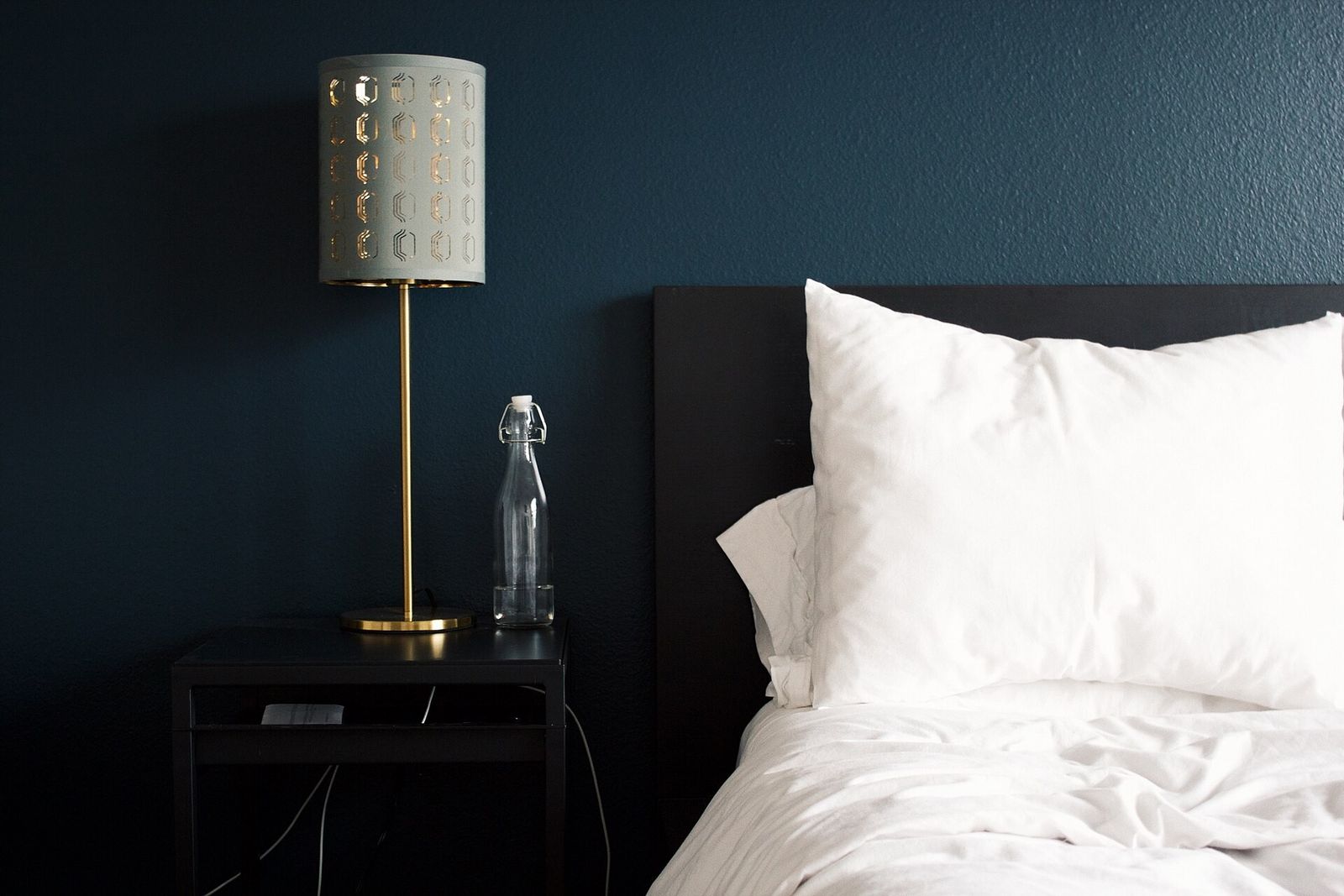
- A bedside table and bed, Alta Yorktown Apartments, Dallas, United States · Photo: Rhema Kallianpur, CC0 (Resized)
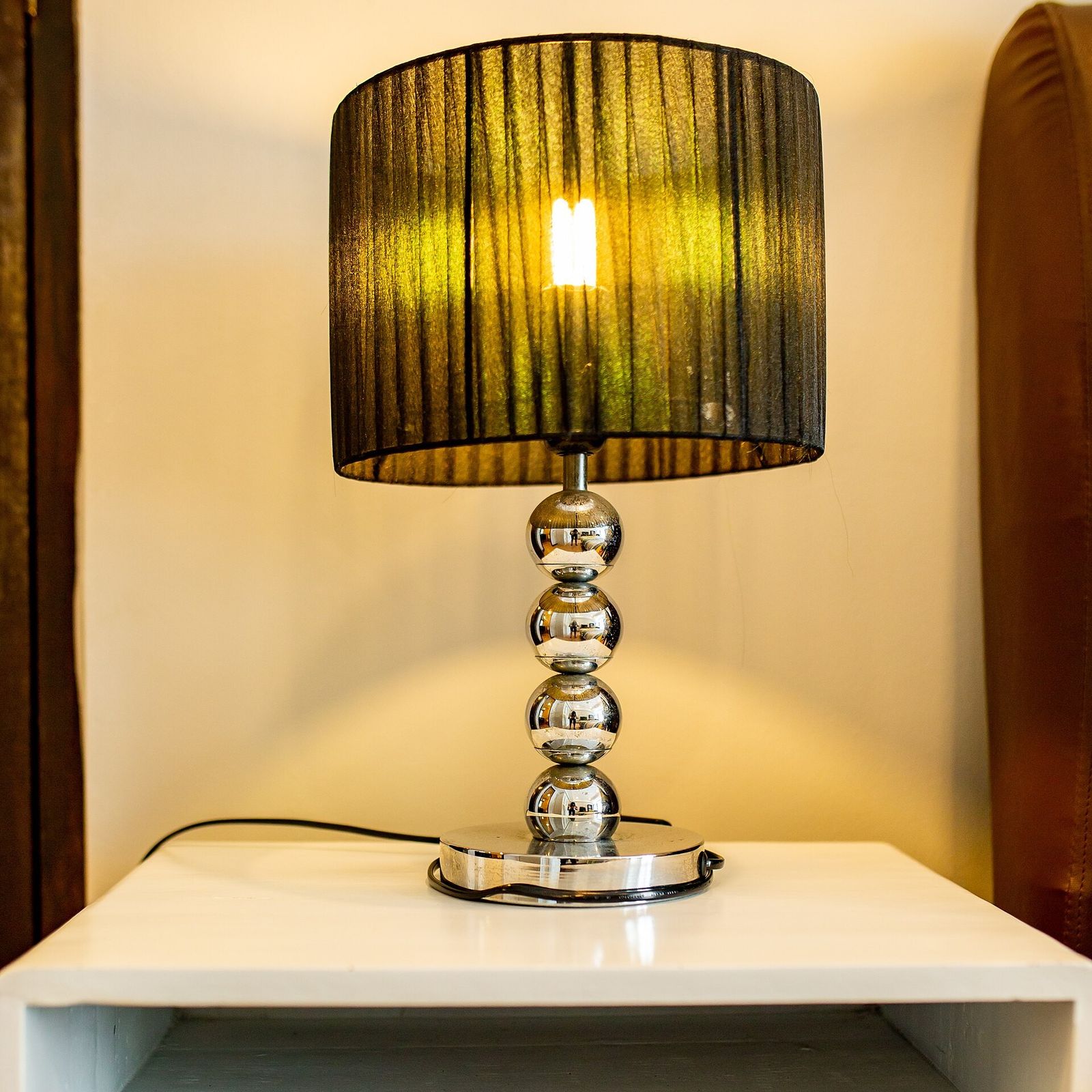
- Chrome bedside table lamp on a nightstand, Phuket, Thailand · Photo: PatongHarbor, CC BY-SA 4.0 (Cropped and resized)
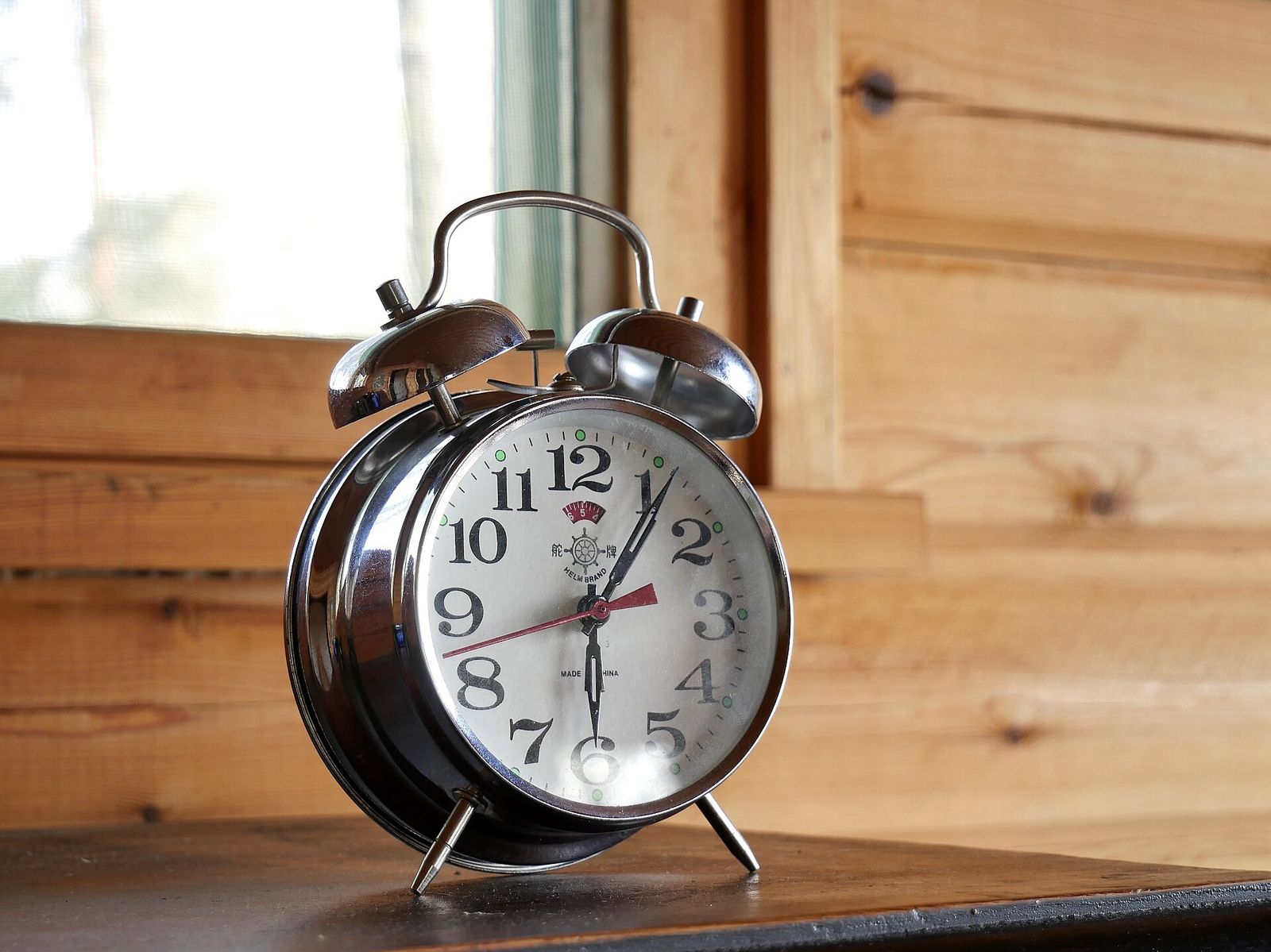
- Classic mechanical alarm clock · Photo: Santeri Viinamäki, CC BY-SA 4.0 (Resized)