 Haplo
Haplo
How Much Screen Time Is Too Much for Adults?
The WHO doesn't name a number of hours, and Canada's guidelines say no more than three a day of screen time for fun. Here's what the research behind those answers shows, what typical use looks like now, and how to set a limit of your own.

Your phone can tell you, to the minute, how long you spent on it yesterday. It can’t tell you how much screen time is too much.
For adults there’s no single agreed number. The World Health Organization tells everyone to sit less but says the evidence isn’t strong enough to set a limit. Canada’s 24-Hour Movement Guidelines do set one: no more than three hours of recreational screen time a day. The research underneath shows which kinds of screen time carry the clearest risks, and how much people gained when they cut back.
Below: what health bodies recommend, what the studies found (small effects included), what typical use looks like in 2026, and how to set your own limit, ending with a weekly schedule. We make Barrier, an iPhone app that locks the apps you choose on a schedule you set, but the schedule works just as well in Apple’s Screen Time or any other blocker. This is general information, not medical advice.
How much screen time is too much? The short answer
- There’s no proven safe number of hours for adults. The WHO’s 2020 guidelines recommend less sedentary time at every age, “although evidence was insufficient to quantify a sedentary behaviour threshold” (Bull and colleagues, 2020).
- Canada’s guidelines draw the line at three hours of recreational screen time a day, within 8 hours or less of sedentary time.
- The long-term risk data is mostly about TV. In a meta-analysis of 34 studies, the risk of death rose more steeply above about 3.5 hours of TV a day.
- Cutting back helps a little, on average, and in the experiments it did at least as well as quitting.
- Our working definition: it’s too much when leisure use runs well past three hours on most days, crowds out sleep, exercise or people, or keeps going longer than you meant.
What health bodies say about adult screen time
| Source | What it says for adults | A number of hours? |
|---|---|---|
| World Health Organization (2020) | Reduce sedentary time, at every age | No: the evidence was insufficient to set a threshold |
| Physical Activity Guidelines for Americans, 2nd edition | Move more and sit less | No |
| Canadian 24-Hour Movement Guidelines (2020) | 8 hours or less of sedentary time, including no more than 3 hours of recreational screen time | Yes: 3 hours a day |
| American Optometric Association | Every 20 minutes, look at something 20 feet away for 20 seconds | No, but eye strain risk is highest from 2 continuous hours a day |
Canada’s guidelines say they were informed by the best available evidence together with expert consensus and stakeholder consultation, and the version for adults 65 and older keeps the same three-hour line. They also ask for 7 to 9 hours of good sleep (7 to 8 from age 65) and at least 150 minutes a week of moderate to vigorous activity, and they add: “Progressing towards any of these targets will result in some health benefits.”
Recreational is the key word. Screen time for work doesn’t count toward the three hours, though it still counts as sitting.
Average screen time for adults in 2026
- Online almost constantly: 41 percent of US adults say they are, in a Pew Research Center survey run from February to June 2025. That includes 63 percent of 18 to 29 year olds and 14 percent of those 65 and over.
- Social and video platforms: internet users aged 16 and over average 18 hours 36 minutes a week on them, well over 2.5 hours a day, according to GWI data in DataReportal’s Digital 2026 report. Women aged 16 to 24 average more than 3 hours 40 minutes a day.
- TV: Americans aged 15 and over watched 2.6 hours a day in 2025, half of all their leisure time, in the American Time Use Survey.
- Phones, logged rather than guessed: about 2,000 US adults on Android phones averaged 333 minutes (5.5 hours) a day of smartphone screen time in spring 2020, early in the pandemic. American and Canadian iPhone users in a trial published in 2025 averaged 314 and 336 minutes in its two groups. Both samples volunteered for phone studies, so they may run heavy.
Your own number matters more, and your guess is probably off. A 2021 meta-analysis of 106 comparisons found that self-reported media use correlates only moderately with logged use and is rarely accurate.
What the research says about screen time and health
Sitting and TV: where the risk is clearest
- Grøntved and Hu (2011) pooled eight cohort studies. Every extra 2 hours of TV a day went with a 20 percent higher risk of type 2 diabetes, 15 percent for cardiovascular disease and 13 percent for death from any cause. In absolute terms, that’s 104 more deaths per 100,000 people a year for each 2 hours.
- Patterson and colleagues (2018) pooled 34 studies of 1,331,468 people, adjusting for physical activity. For deaths from any cause and from cardiovascular disease, they identified thresholds of 3 to 4 hours a day of TV and 6 to 8 hours of total sitting, above which risk is increased.
- Ekelund and colleagues (2016) harmonised data on more than a million people. About 60 to 75 minutes a day of moderate activity seemed to eliminate the extra risk of death linked to long sitting, but only reduced the risk linked to watching 3 or more hours of TV a day.

These are observational studies, mostly of self-reported TV time, so they can’t prove cause, and none measured phone use. They do suggest the kind of screen time matters. In 146,651 UK Biobank participants aged 60 and over, more TV time was linked with a higher risk of dementia and more computer time with a lower risk, whatever their activity levels. Long, passive, seated stretches look like the pattern to watch, on any screen.
Mood and wellbeing: small effects, and cutting back beats quitting
- Four weeks off Facebook. In a study of 1,661 US Facebook users, economists paid a randomly chosen group to deactivate their accounts for the four weeks before the 2018 midterm elections. That freed up about an hour a day and raised subjective wellbeing by 0.09 standard deviations: small but significant, the authors say, and far smaller than a correlational analysis would have suggested.
- Thirty minutes of social media a day. Melissa Hunt’s team at the University of Pennsylvania had 143 undergraduates either use social media as normal or cap Facebook, Instagram and Snapchat at 10 minutes each a day for three weeks. Loneliness and depression fell significantly in the capped group, most clearly in people who started out more depressed.
- An hour less, or none at all. In Germany, 619 smartphone users were split three ways: a week with no smartphone at all, an hour less a day, or no change. Both changes eased depressive and anxiety symptoms, but most effects were stronger and lasted better over four months in the one-hour-less group.
- Two weeks without mobile internet. In a trial published in 2025, 467 American and Canadian iPhone users agreed to block mobile internet for two weeks, keeping calls and texts. In the first group, daily screen time fell from 314 to 161 minutes, and mental health, wellbeing and an objective test of sustained attention improved. But only 119 of the 467 kept the block on for at least 10 of the 14 days, 83 percent came in motivated to cut back, and everyone knew the study was about phones and wellbeing.
Quitting outright is less convincing. A 2025 meta-analysis of ten social media abstinence studies with 4,674 participants found no significant effect on positive mood, negative mood or life satisfaction. The experiments point to less rather than zero.
Why limits set in advance help
In the Android study, the researchers offered some participants a tool to set a daily limit for each app. Changes took effect the next day, and in most cases a limit couldn’t be overridden on the spot. With no payment for using it, 78 percent set limits that actually restricted them, and time on social apps, YouTube and web browsers fell by 22 minutes a day (16 percent) over 12 weeks. People in the comparison group repeatedly underestimated their own future use, and the authors’ model attributes 31 percent of social media use to self-control problems. The lesson: set limits when you’re calm, not when you want to scroll.
Signs your screen time is too much for you
These are questions to ask yourself, not a diagnosis:
- Is it cutting into your sleep? Canada’s guidelines ask for 7 to 9 hours. More in our guide to phones and sleep.
- Is your leisure screen time well over three hours on most days?
- Are you sitting for more than 8 hours a day, or getting less than 150 minutes a week of moderate activity?
- Do you use your phone longer than you meant to, to put things off, or without noticing? These are items from the addiction index in the Android study, and the limits reduced them.
- Is it replacing time with people you’d rather see?
If your phone use is tangled up with low mood or anxiety that doesn’t lift, talk to a doctor. Limits are a tool for habits, not a substitute for care.
How to set your own screen time limit
- Measure a normal week. On an iPhone, go to Settings, then Screen Time, then Daily Average, and tap Week, as Apple’s guide describes. Note your daily average, how much of it is leisure, and your top three apps.
- Separate needs from choices. Maps, calls, messages and work are needs. Feeds, video and games are choices, and they’re what the three-hour guideline and your limit are about.
- Pick a first target from the table below.
- Set it in advance, and make changes wait a day, as the limits in the Android study did. Give it four weeks, then check your Daily Average again.
| Your leisure use now | First target | Where it comes from |
|---|---|---|
| More than 4 hours a day | One hour less a day | The German trial, where an hour less a day beat a full break |
| 3 to 4 hours a day | Under 3 hours | Canada’s guidelines and the TV studies’ 3 to 4 hour thresholds |
| Under 3 hours, but feeds leave you feeling worse | 30 minutes a day across social apps | The Pennsylvania trial’s 10 minutes on each of three apps |
A weekly screen time schedule you can copy
This is our suggestion, not a protocol from a study. It aims for under three hours of leisure screen time, a 30-minute daily cap on social apps and a cutoff that protects 7 to 9 hours of sleep. Shift the times to fit your day.
| Block | When | What’s locked | Why |
|---|---|---|---|
| Night | Every day, 21:30 to 7:30 | Everything except calls, messages, alarms and maps | An hour’s buffer before a 22:30 bedtime |
| Morning | Every day, 7:30 to 8:30 | Social, video and games | Starts the day on your plans, not your feeds |
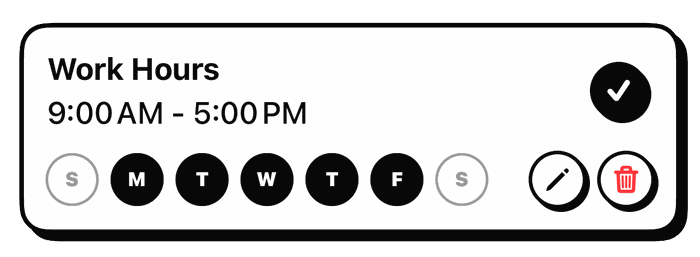
| Work | Monday to Friday, 9:00 to 17:00 | Social, video and games | Split it in two to leave lunch open |
| Evening | Every day, 17:00 to 21:30 | Nothing, but social apps share a 30-minute daily allowance | Leisure time, with the Pennsylvania trial’s 30-minute cap |
In Screen Time on iOS 27, build the blocks as time windows in a Screen Time Schedule, add a Social Media category under Time Allowances, and put the people and apps you must always reach under Always Allowed (Apple’s guide). Our iPhone Screen Time guide covers every setting. In an app blocker, make each block its own schedule. If feeds are most of your leisure time, pair this with our plan to stop doomscrolling.
Screen time FAQ
Is 4 hours of screen time a day too much?
If it includes work, not necessarily. Four hours of leisure is above Canada’s three-hour guideline and in the range of daily TV where the long-term studies saw risk climb faster.
Is 7 hours of screen time bad if it’s mostly work?
It’s outside Canada’s three hours, but it is sitting. Risk rose above 6 to 8 hours of total sitting in the pooled studies, and 60 to 75 minutes of moderate activity a day seemed to offset it. Get up between tasks, and use the 20-20-20 rule for your eyes.
Is it better to quit social media or cut back?
Cut back. In the German trial, an hour less a day beat a week without a smartphone on most outcomes, and the meta-analysis of social media breaks found no reliable gain from abstaining.
How we made this
We started from the guidelines themselves, then read each study’s full text or PubMed abstract for the figures quoted here, and left out numbers we couldn’t trace to a primary source. Apple’s steps come from its iOS 27 support pages. The target table and the schedule are our suggestions built on those studies, not a tested package. The Barrier details come from the app’s source code: it locks the apps or categories you pick during schedules you set for chosen days and times. The photos are from Wikimedia Commons.
References
- Bull FC, et al. World Health Organization 2020 guidelines on physical activity and sedentary behaviour. British Journal of Sports Medicine. 2020;54(24):1451-1462.
- Canadian Society for Exercise Physiology. Canadian 24-Hour Movement Guidelines: Adults 18-64 years and Adults 65 years or older. 2020.
- Office of Disease Prevention and Health Promotion. Top 10 things to know about the second edition of the Physical Activity Guidelines for Americans.
- American Optometric Association. Computer vision syndrome.
- McClain C, Bishop W. What we know about internet use, smartphone ownership and digital divides in the U.S. Pew Research Center. 2026.
- Kemp S. Digital 2026: Global Overview Report. DataReportal. 2025.
- US Bureau of Labor Statistics. American Time Use Survey: 2025 results. 2026.
- Parry DA, et al. A systematic review and meta-analysis of discrepancies between logged and self-reported digital media use. Nature Human Behaviour. 2021;5(11):1535-1547.
- Grøntved A, Hu FB. Television viewing and risk of type 2 diabetes, cardiovascular disease, and all-cause mortality: a meta-analysis. JAMA. 2011;305(23):2448-2455.
- Patterson R, et al. Sedentary behaviour and risk of all-cause, cardiovascular and cancer mortality, and incident type 2 diabetes: a systematic review and dose response meta-analysis. European Journal of Epidemiology. 2018;33(9):811-829.
- Ekelund U, et al. Does physical activity attenuate, or even eliminate, the detrimental association of sitting time with mortality? The Lancet. 2016;388(10051):1302-1310.
- Raichlen DA, et al. Leisure-time sedentary behaviors are differentially associated with all-cause dementia regardless of engagement in physical activity. PNAS. 2022;119(35):e2206931119.
- Allcott H, Braghieri L, Eichmeyer S, Gentzkow M. The Welfare Effects of Social Media. American Economic Review. 2020;110(3):629-676.
- Hunt MG, Marx R, Lipson C, Young J. No More FOMO: Limiting Social Media Decreases Loneliness and Depression. Journal of Social and Clinical Psychology. 2018;37(10):751-768. Summary: Penn Today.
- Brailovskaia J, et al. Finding the “sweet spot” of smartphone use: Reduction or abstinence to increase well-being and healthy lifestyle?! Journal of Experimental Psychology: Applied. 2023;29(1):149-161.
- Castelo N, et al. Blocking mobile internet on smartphones improves sustained attention, mental health, and subjective well-being. PNAS Nexus. 2025;4(2):pgaf017.
- Lemahieu L, et al. The effects of social media abstinence on affective well-being and life satisfaction: a systematic review and meta-analysis. Scientific Reports. 2025;15(1):7581.
- Allcott H, Gentzkow M, Song L. Digital Addiction. American Economic Review. 2022;112(7):2424-2463.
- Apple Support. Set up Screen Time for yourself on iPhone and Set Screen Time Schedules and Time Allowances in Screen Time on iPhone.
Image credits
- Clock and banana on a table with a smartphone and a plant · Photo: Shixart1985, CC BY 2.0 (Resized)
- Person holds a remote control while sitting on a couch · Photo: Shixart1985, CC BY 2.0 (Resized)